How to Make Lilac Enfleurage at Home (Step-by-Step Beginner's Guide)
Last updated March 13, 2026
Lilac season lasts about two weeks where I live. Every May I walk out to my front yard, bury my face in a cluster, and think: I need to make this last. That's what lilac enfleurage is for.
It sounds fancy — an old French perfumery technique, the kind of thing artisans charge $35 to $395 for — but the actual process is remarkably simple. Ten minutes of active work per day, for as many days as your lilacs are blooming. What you end up with is a softly scented solid called a pomade that you can use as a solid perfume, body moisturizer, or base for body butter.
At a Glance:
- What it makes: Natural lilac-scented pomade (solid perfume, moisturizer, body butter base)
- Active time: ~10 minutes per day
- Total duration: 5 to 30+ days during lilac season
- Fat options: Refined shea butter, refined coconut oil, lard, or tallow
- Season: May in most of the US (April in warmer climates, June in northern regions)
What Is Lilac Enfleurage?
Enfleurage is a method of transferring the fragrance of living flowers into a solid fat. Over the course of days or weeks, the fat absorbs the flowers' scent — and when the blooms are gone for the season, you're left with a pomade that holds their fragrance.
I do this every spring and it's become one of my favorite homestead rituals. It's quiet, patient work. You harvest flowers in the morning, lay them on the fat, cover it, and go about your day. The fat does the rest. And when you open that jar three weeks later, your whole kitchen smells like the lilac bush.
Why Lilacs Need Enfleurage (And Why There's No Such Thing as Real Lilac Essential Oil)
Here's something that took me years to realize: the lilac essential oil you see at craft stores and online is almost certainly synthetic. True lilac essential oil doesn't exist in any meaningful commercial quantity. This is why it always smells a little "off" — like a memory of lilacs rather than the real thing.
The reason has to do with how lilac scent works. In roses, the fragrance oil actually lives inside the petals and can be extracted by distillation or solvent. Lilacs are different. The scent doesn't exist in the petals themselves — it's produced by tiny living scent glands inside each individual floret, and exhaled into the air while the flower is alive. Steam distillation destroys that scent completely. Soaking lilacs in alcohol kills the gland immediately, getting you almost nothing.
The only way to capture true lilac fragrance is to keep the florets alive and let them breathe their scent directly into a surrounding fat. Solid fat has a remarkable ability to absorb aromatic compounds from the air — it's the same principle behind why butter stored in a refrigerator can absorb faint odors from its surroundings, even through packaging. Enfleurage exploits this deliberately. The fat breathes in the lilac's exhaled fragrance, and you end up with something no bottle of synthetic oil can replicate.
What You Need
The Fat
Any unscented solid fat that stays solid at room temperature will work. Here's how the main options compare:
- Refined shea butter — My recommendation for beginners. It's stable, has virtually no scent of its own, and gives a beautiful creamy texture in the finished pomade. Find refined shea butter online or at most health food stores.
- Refined coconut oil — Easy to find at any grocery store and works well. One note: it melts in warm weather (above about 76°F), which can be tricky if your kitchen runs warm in May.
- Lard or tallow — The traditional choice. French perfumers in Grasse used rendered animal fat for centuries, and for good reason — it's excellent. If you render your own from homestead animals, this is a beautiful farm-to-beauty pipeline.
The key word is refined for shea and coconut. Raw or unrefined versions have strong scents of their own that will compete with and muddy the lilac.
The Container
Wide and shallow beats tall and narrow. More surface area means more flowers touching the fat, which means faster and better scent saturation. A wide glass food storage container with a lid is ideal. A lidded glass casserole dish works perfectly. Avoid mason jars — they're too narrow to be efficient.
Harvesting Lilacs for Enfleurage
Harvest in the morning, after the dew has dried but before afternoon heat sets in. This is when the flowers are at their fragrant peak.
Choose clusters that are fully open and intensely fragrant. Skip anything that's starting to brown, fade, or drop petals — those flowers have stopped producing scent.
Remove ALL green stems, leaves, and woody parts before adding anything to the fat. This is the most important step beginners miss. Green plant material adds a bitter, grassy smell that will ruin your pomade. I learned this the hard way my first year — I got lazy with a handful of stems and the whole batch smelled like lawn clippings with a faint hint of lilac. Remove the greens.
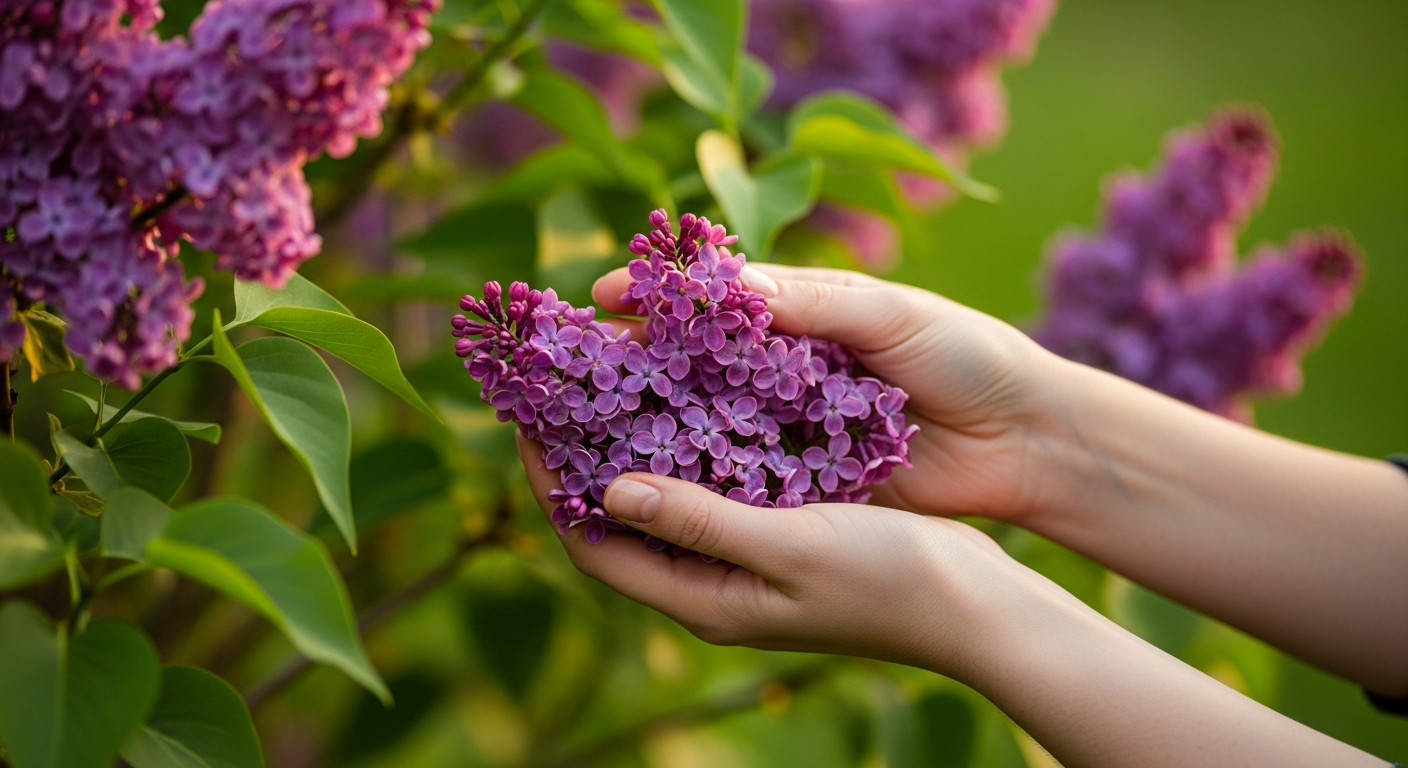
Pull the individual florets off the clusters. If you want to be precise: leave the tiny green sepals (the base of each floret) intact. Those sepals hold moisture that keeps the floret alive longer, which means a little more scent production over those 24 hours. But honestly, don't let perfect be the enemy of good — just get the flowers on the fat.
How to Make Lilac Enfleurage (Step-by-Step)
This is much easier than it sounds. Here's the full process:
- Gently melt your fat on the lowest heat setting — just until liquid. Don't let it bubble or boil.
- Line your container with parchment paper (optional but highly recommended — it makes removing spent flowers much less tedious the next day).
- Pour a thin, even layer of fat into the container — about ¼ inch deep. Thinner layers saturate faster.
- Let the fat solidify completely — 30 to 60 minutes at room temperature, or 10 to 15 minutes in the fridge.
- Harvest and prep your lilacs in the morning. Remove all greens.
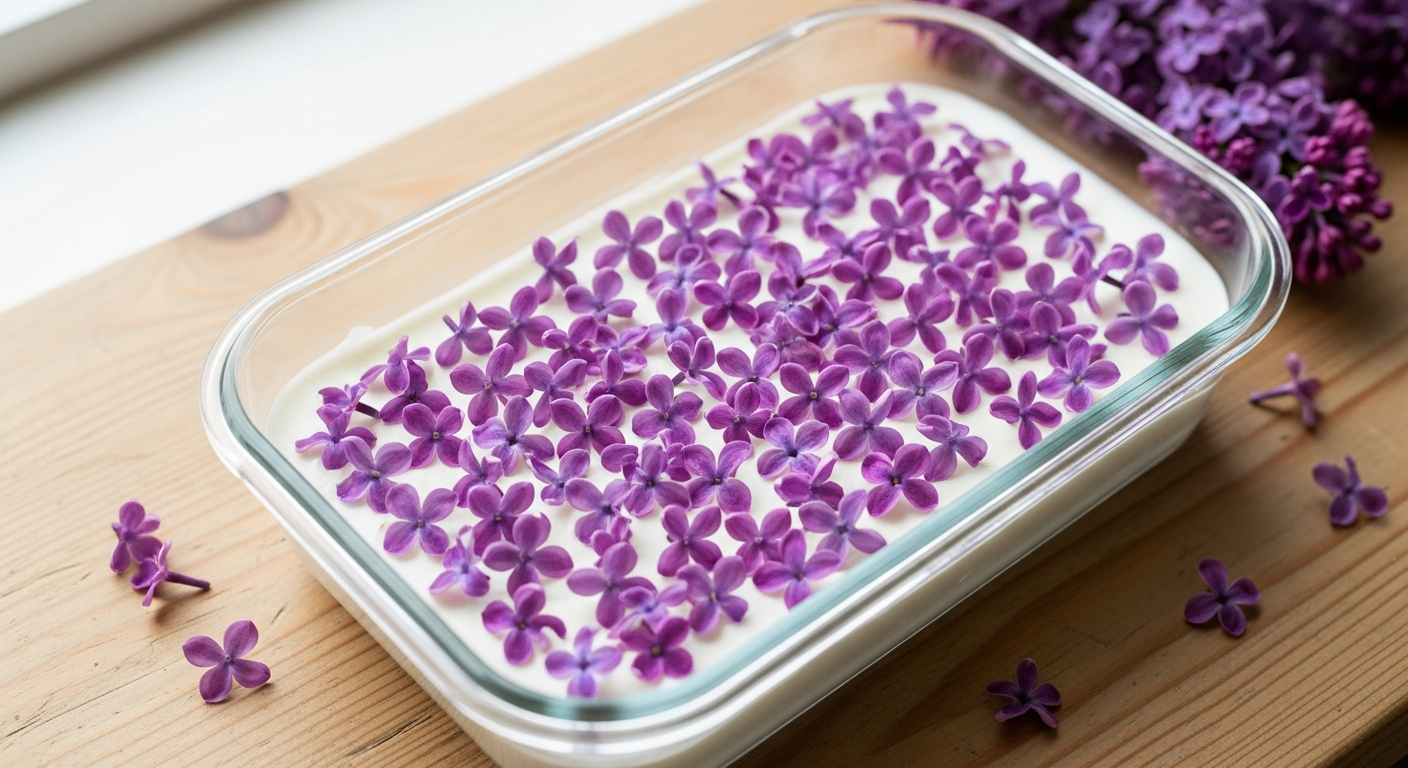
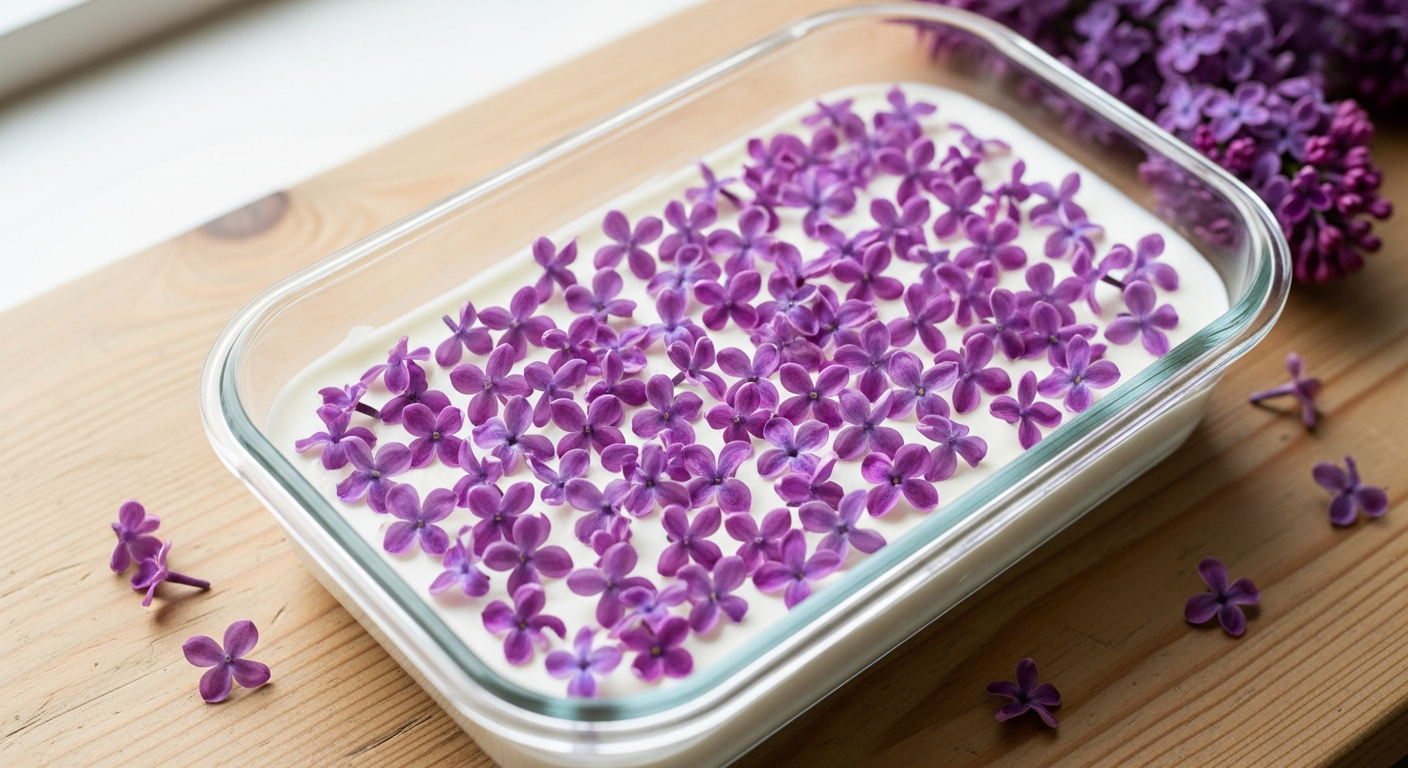
- Spread the blossoms in a single even layer over the fat surface. They should cover it without being piled too deep.
- Cover with the lid to trap the fragrance inside. Set aside for 24 hours.
- After 24 hours, remove the spent blossoms. They'll look wilted and translucent. If they're stuck to the fat, set the container in a bowl of slightly warm water for a few minutes to soften the surface — then they'll lift off cleanly.
- Replace with fresh blossoms and cover again. Repeat daily.
- When you're done (see timing guidance below), scoop the pomade into small glass jars and seal tightly.
How Long Does It Take?
This depends entirely on how strong you want the scent to be.
- 5 or fewer flower changes: A light, gentle scent — lovely for daily skin use
- 7–14 flower changes: Well-saturated pomade, good for solid perfume — the beginner sweet spot
- 3–6 weeks of daily changes: Maximum saturation, closest to what artisan producers make ($35–$395 worth)
One honest note: even at full saturation, authentic lilac enfleurage is a soft, intimate scent. It's not a projection fragrance. Apply it to your pulse points — wrist, neck — and give it a few minutes to warm on your skin before you smell it. You and the people close to you will catch it. This is what real lilacs actually smell like up close, not from across the room. And once you experience it, no synthetic version will satisfy you again.
How to Use Lilac Enfleurage
The pomade is more versatile than you might expect:
- Solid perfume: Apply a small amount to pulse points and let it warm for a few minutes before inhaling
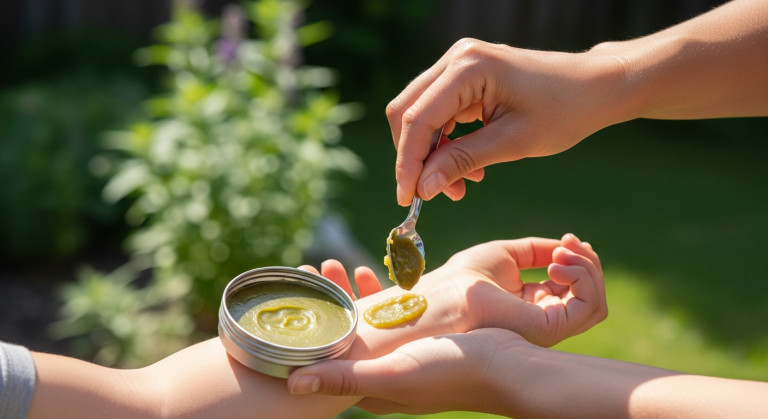
- Body moisturizer: Scoop a small amount, warm between your palms, smooth onto skin
- Whipped body butter: Beat shea-based pomade with a hand mixer until light and fluffy — use like a regular body butter
- Lip balm or lotion bars: Melt with a small amount of beeswax, pour into tins, let set
How to Store It
Keep your pomade in a cool, dark place — a pantry shelf or closet works well. It should stay good for 6 to 12 months depending on the freshness of the fat you started with. If you notice a thin liquid layer under the fat, that's moisture from the flowers — it doesn't mean the pomade has spoiled. Carefully pour it off or remove it with a small syringe.
Frequently Asked Questions
How long does enfleurage take?
Five or fewer flower changes gives you a light, delicate result. Seven to fourteen changes produces a well-saturated pomade that works well as a solid perfume — the beginner sweet spot. A full lilac season of daily changes (three to six weeks) gets you the most saturated, aromatic result.
Is there such a thing as real lilac essential oil?
Not in any meaningful commercial quantity. Lilacs can't be steam distilled — the heat destroys the delicate scent entirely. Any "lilac essential oil" you find online or in stores is almost certainly synthetic. Enfleurage is the only authentic method for capturing true lilac fragrance.
What fat works best for lilac enfleurage?
Refined shea butter is the best choice for beginners — stable, easy to work with, and nearly scent-neutral. Refined coconut oil also works well and is easy to find at any grocery store. Lard and tallow are the traditional historical options; if you render your own, these connect you to the centuries-old origins of this craft.
Why does my lilac enfleurage barely smell like lilac?
This is completely normal with authentic enfleurage. Real lilac scent is naturally subtle and close-range. If you want a stronger result, run more flower changes (14 or more days) and make sure you're harvesting flowers at their absolute peak freshness — fully open blooms on a dry morning.
Can I use any variety of lilac?
Yes — any Syringa variety that smells good to you will work. The more fragrant the variety, the stronger your enfleurage. Old-fashioned common lilac (Syringa vulgaris) tends to have the most intense fragrance. Avoid cultivars with little or no scent — they won't give you much result.