How to Trap a Skunk Without Getting Sprayed: A Beginner's Guide for 2025
Last updated March 11, 2026
Here's the short answer: skunks rarely spray inside a live trap, as long as you cover the trap with a blanket before you approach it. Skunks spray what they can see — and a covered trap means the skunk can't see you coming. I've trapped skunks near my chicken coop a few times now, and once I learned the blanket trick, I stopped being nervous about the whole thing. The process is simpler than it sounds, and by the end of this guide, you'll know exactly what to buy, where to put it, and how to handle what's inside when you check it in the morning.
| Best beginner trap | Havahart medium wire cage |
| Best spray-proof option | JT Eaton 475N or #6 Tuff Trap |
| Best bait | Canned cat food or tuna |
| When to set | Morning; check at dawn |
| Will it spray in the trap? | Rarely — cover the trap with a blanket |
| Can you relocate? | Varies by state — check your local laws first |
Skunk Trap Types: Which One Do You Actually Need?
The first decision is which type of trap you're buying, because there are two very different options out there and they're not interchangeable.
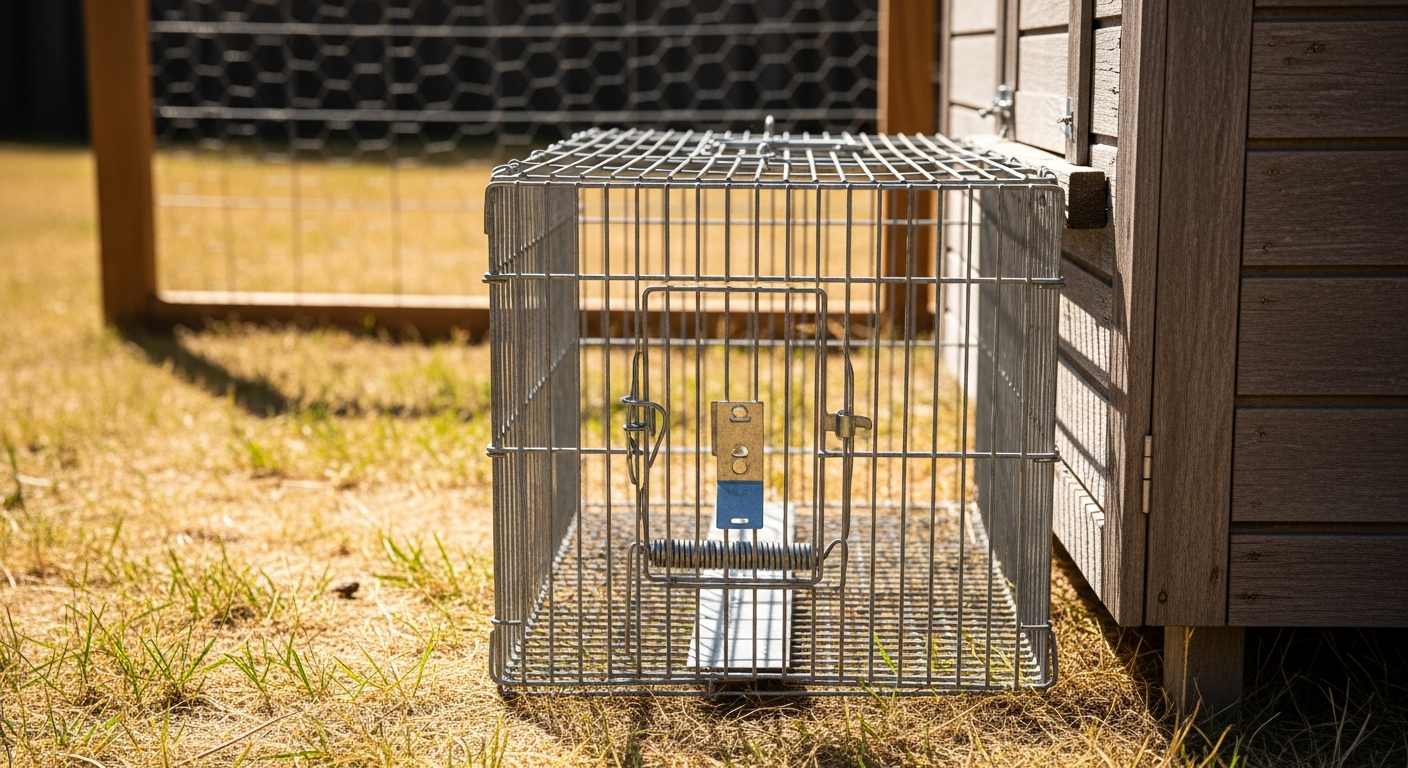
Wire cage traps (Havahart is the most common brand) look exactly like you'd expect — a metal wire cage with a trigger plate inside and a spring-loaded door. They run $45–$80, they're available on Amazon and at most farm supply stores, and they're what most backyard homesteaders use for a one-time skunk problem. The skunk can see out through the wire, which does create some spray risk — but draping a blanket over the trap when you set it fixes this almost entirely. More on that in the checking section below.
Spray-proof enclosed traps are solid-walled tubes made from PVC or polyethylene. The skunk walks in, the door closes, and the animal is completely enclosed in a dark box. It can't see out, which means it doesn't feel threatened, which means it almost never sprays. The JT Eaton 475N and the Tuff Trap #6 are the two you'll see most often in this category, running $75–$135. These are what pest control professionals use, and they're worth the extra cost if you're dealing with repeat skunks or setting the trap somewhere a blanket won't work well.
| Wire Cage | Spray-Proof Enclosed | |
|---|---|---|
| Price range | $45–$80 | $75–$135 |
| Spray risk | Low (with blanket cover) | Very low |
| Ease of use | Very easy | Easy |
| Where to buy | Amazon, Tractor Supply, hardware stores | Online specialty stores, Amazon |
| Best for | First-time use, yard and coop perimeter | Repeat problems, under-deck situations |
For most of you reading this, the wire cage trap is the right call. It's affordable, easy to find, and works well when you use it correctly. I'd only spend the extra money on a spray-proof trap if I'd already had a spray incident or if the trap was going somewhere I couldn't drape a blanket.
Wire Cage Traps (Havahart-Style)
A standard Havahart medium trap handles skunks easily. The medium size is the sweet spot — big enough for a full-grown skunk, small enough that it's manageable to carry. The "Easy Set" version has a lever that lets you set the trigger without reaching inside the trap, which is a nice feature if you're setting it near an active burrow.
The only thing to know before you buy: cover it with a blanket or old towel when you set it. This makes a huge difference in spray risk when you come back to check it. A covered skunk is a calm skunk.
Spray-Proof Enclosed Traps
These traps are worth the extra cost in specific situations. If you're setting a trap under a low deck where a blanket won't cover it properly, or if you're dealing with a skunk that's already sprayed once and you don't want a second incident, a spray-proof trap removes most of the risk entirely. The polyethylene or PVC walls block the skunk's view completely, and a skunk that can't see a threat rarely fires.
The tradeoff is price and availability. You probably won't find one at Tractor Supply — they're mostly sold through online trapping supply stores. But if you're dealing with a recurring skunk problem, the extra investment pays for itself.
Best Skunk Trap Bait (Most People Use the Wrong Thing)
Skunks are omnivores, which means they'll eat almost anything — but they're especially drawn to strong, fatty smells. Skip the fresh vegetables and plain bread. Those work on rabbits, not skunks.
What actually works:
- Canned cat food — This is my first recommendation. It's cheap, it smells strongly enough to attract a skunk from a distance, and you probably already have it if you have barn cats. Any flavor works; fish-based varieties tend to have a stronger scent.
- Tuna or sardines — Same principle as cat food. Open the can, place it at the back of the trap. Works well, especially in warmer weather when the smell travels farther.
- Peanut butter spread on a cracker or bread — Works, but not as reliably as the fish-based options. Better than nothing if that's all you have.
- Scrambled eggs — This works surprisingly well, especially near a chicken coop where skunks are already investigating egg smells.
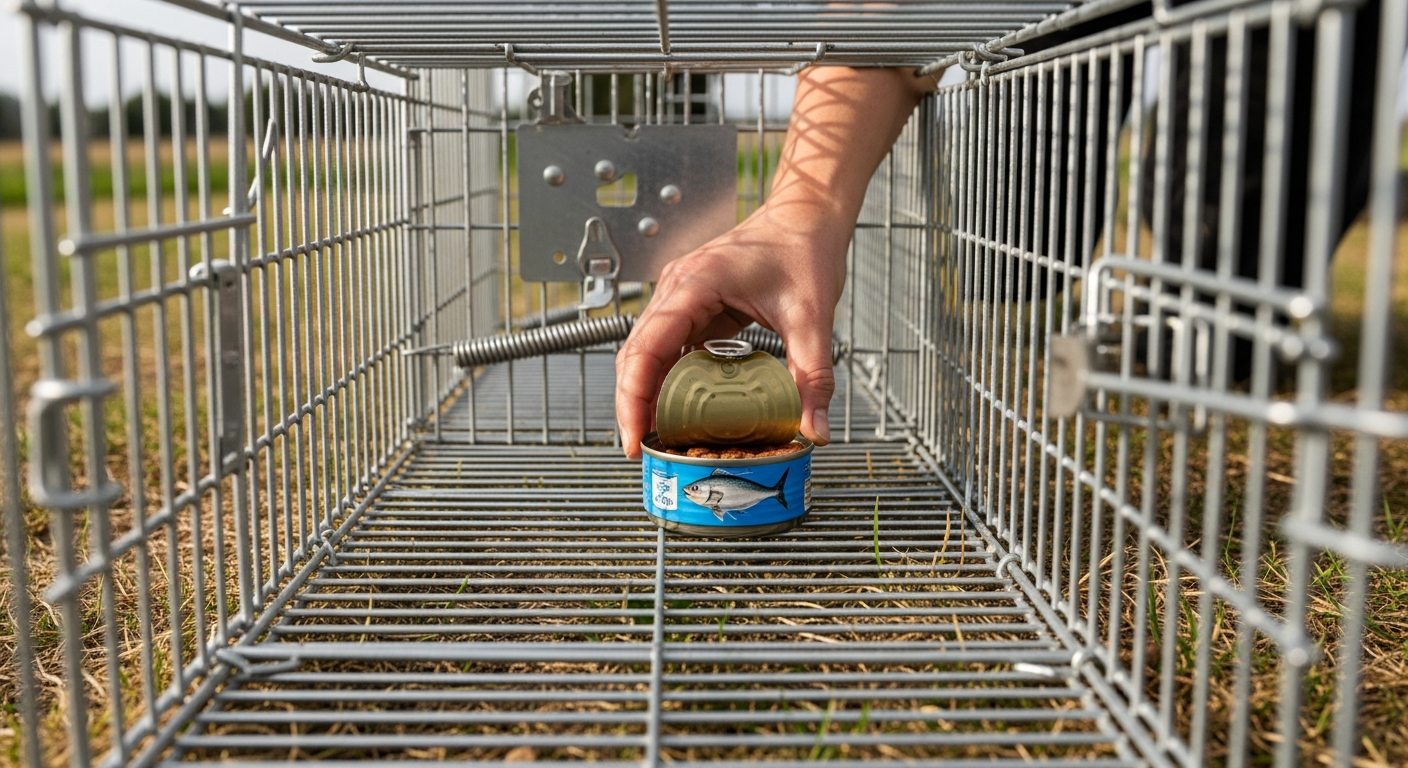
What doesn't work: Fresh vegetables, fruit alone, or plain bread. Skunks aren't interested in light, neutral smells. You need something with enough pungency to pull them in from across the yard.
How to place it: Put the main bait at the very back of the trap, as far from the door as possible — this forces the skunk to fully enter before triggering the plate. Leave a small trail of a few crumbs or drops leading from the door to the back. Don't overdo the trail; you want the main reward to be inside.
Where to Put a Skunk Trap (Placement Tips That Actually Work)
Placement matters more than most people realize. A trap in the wrong spot can sit empty for a week while the skunk walks right past it every night.
Set it along a wall or fence line. Skunks don't walk across open yard space — they travel along edges. Set the trap flush against a fence, the side of a building, or the base of a deck. This is the same reason mouse traps go along baseboards. The skunk's natural path runs right past your trap.
Put it near the entry point. If you know where the skunk is coming from or where it's entering under a structure, that's where the trap goes. A trap set 30 feet from the burrow entrance catches far fewer skunks than one set right at the opening.
Timing: Set the trap in the morning after you've confirmed skunk activity. Skunks are nocturnal, so they'll investigate the bait overnight. Check the trap at dawn — before the animal has been sitting in the heat of the day and before it's had time to get agitated.
One practical note: don't set the trap the same night you want to check it at 6 a.m. Set it one morning, check it the next morning. That gives the skunk a full night to find the bait.
How to Trap a Skunk Under Your Deck, Porch, or Shed
This is the most common scenario I hear about — the skunk isn't wandering through the yard, it's moved in under a structure. The approach is a little different here.
Method 1: Trap at the burrow entrance (simplest)
Place the trap flush against the main opening where the skunk is getting in and out. Cover the trap with a blanket, leaving just the entrance uncovered. The skunk will exit at night to forage, and when it returns in the early morning hours, it'll investigate the bait in the trap. Make sure you've identified the main entrance — skunks often dig multiple entry points, so block all of them except the one where you've placed the trap.
Method 2: One-way exclusion door (non-lethal)
If you'd prefer not to trap the skunk at all and just want it gone, a one-way exclusion door works well. You install it over the main entrance: the skunk pushes out when it leaves at night, but can't push back in from the outside. After a few days, the skunk will find somewhere else to live.
Here's the critical step everyone skips: seal all other entry points first, before you install the exclusion door. If there are three holes and you only close two of them, the skunk just comes back through the third one. Once you're confident the skunk is out (give it 4–5 nights), remove the exclusion door and seal that opening permanently with hardware cloth buried several inches into the ground to prevent re-digging.
This non-lethal method takes more time but means you don't have to deal with a live skunk in a trap.
Can You Make a Homemade Skunk Trap?
Yes — the bucket method is a real option and it works. Here's how it goes: you dig a hole in the ground and set a 5-gallon bucket so the rim sits flush with the surface. Build a board ramp leading from the ground down to the rim, and put your bait (tuna, cat food) at the bottom of the bucket. The skunk smells the bait, walks down the ramp, and drops into the bucket. Because the bucket is narrow, the skunk can't raise its tail to spray effectively — so it's spray-proof by design.
The honest take: this method works, but it's better suited to situations where you're catching skunks repeatedly or you genuinely want to spend nothing on equipment. For a one-time skunk problem, a wire cage trap is going to be more reliable and easier to set up than digging a hole. The bucket method has weather limitations (rain fills the hole), can't be used on gravel or pavement, and requires digging — which not everyone wants to do.
If you're handy and you've got a persistent skunk problem and you'd rather not spend $50, the bucket method is worth trying. Otherwise, a Havahart trap is a simpler solution for most people.
How to Check Your Trap (and Not Get Sprayed)
This is the part everyone's anxious about, and I get it. But with the right technique, it's very manageable.
Before you approach: Bring a blanket or large towel — something dark and durable that can completely cover the trap. If you set your trap with a cover already on it, that blanket is already there.
Watch for warning signs first. Before you get within 10 feet of the trap, look for these three signals:
- Tail raised and fanned out
- Front feet thumping repeatedly on the trap floor
- Rear end rotating to face you
If you see any of these, stop. Back away slowly and give it 20–30 minutes. Come back when things are quieter. Don't rush this.
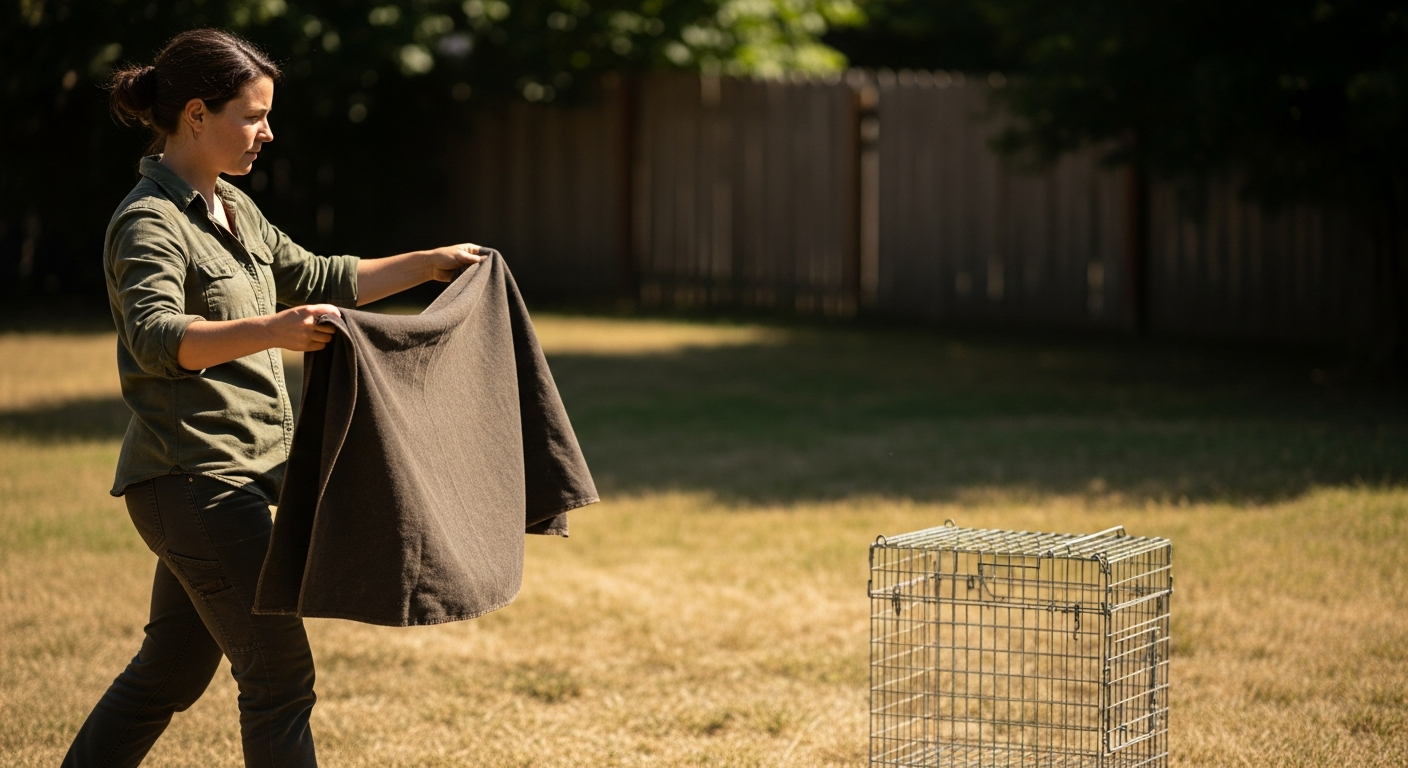
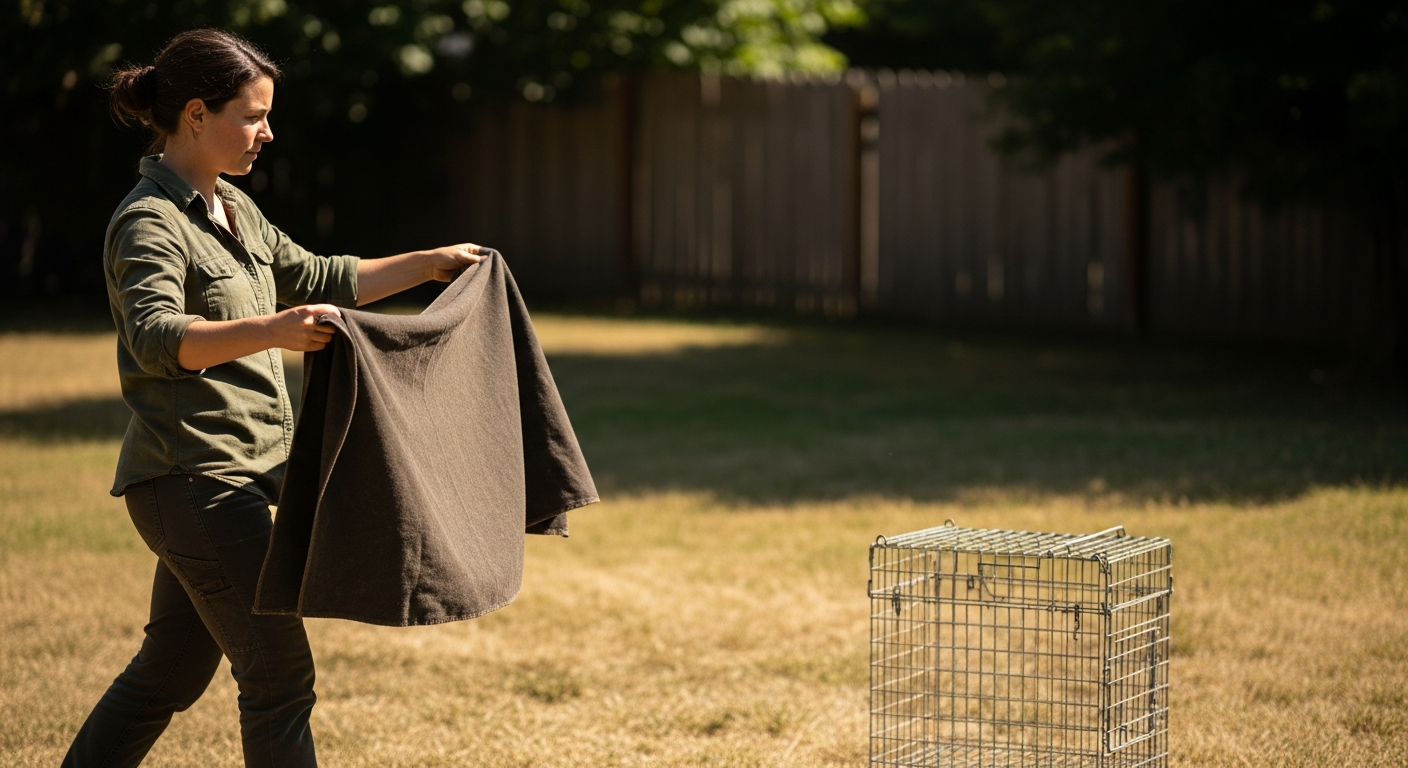
If the skunk is calm: Walk toward the trap holding the blanket open in front of you like a shield. Drape it completely over the trap from the door end. Move slowly and quietly. The skunk can no longer see you, and its threat response should settle.
Picking up the trap: Grab the trap from the door end — the end opposite where the skunk is sitting. Keep it low and level. Don't swing it. Carry it to your vehicle or to wherever you're taking it.
Keep pets inside while you do all of this. A dog or cat showing up mid-process is a guaranteed way to escalate the situation.
I keep a bottle of a skunk odor remover on hand just in case — it's the best thing I've found for cleanup if something goes sideways.
What to Do After You Catch a Skunk
Once you've got a skunk in a trap, you have a few options. Which one makes sense depends on your situation and your local laws.
Option 1: Relocate it
This is what most people want to do — load the trap into the truck and release the skunk somewhere far from home. The rule of thumb is at least 5 miles away, and ideally into a wooded or rural area with good cover. Skunks have small home ranges, so 5 miles is usually enough that they won't return.
Here's the important caveat: relocation is actually illegal in many states. Wildlife agencies prohibit it because it can spread disease — skunks are a rabies vector, and moving them between areas creates transmission risks. Before you drive off with a live skunk in your truck bed, spend 60 seconds on your state's fish and wildlife agency website and confirm that relocation is allowed. This isn't something to skip.
Option 2: Euthanize it
Some homesteaders choose this, especially for repeat offenders near a chicken coop or when relocation isn't legal. I'm not going to walk through the method here — it's a personal decision and there are local regulations to follow. Your county extension office or state wildlife agency can point you in the right direction.
Option 3: You caught the wrong animal
If you opened the blanket and found a cat, opossum, or groundhog instead of a skunk, release it without picking up the trap. Prop the door open from a distance using a stick or your foot, step back, and let the animal find its own way out. Give it space and time — most non-target animals will leave within a few minutes once they realize the door is open.
After any of these outcomes: Seal the entry point the same day. Skunks are territorial, and the burrow under your deck is now a desirable piece of real estate — another skunk will claim it quickly if you leave the hole open. Hardware cloth buried 6 inches into the ground is the best deterrent.
If you've got skunks getting into your chicken coop specifically, that's a related but separate problem worth reading about further — they're after the eggs, and there's more to the story than just trapping.
What to Do If the Skunk Sprays
If you get sprayed despite all precautions, here's what actually works:
The formula: 1 quart of 3% hydrogen peroxide + 1/4 cup of baking soda + 1 teaspoon of dish soap. Mix it and apply immediately. Leave it on for 5 minutes, then rinse. Don't let it sit longer — hydrogen peroxide can lighten fabric and skin. For dogs, keep it out of their eyes. For the trap itself, set it outside in full sun for a day or two, or soak it in a diluted bleach solution.
Why tomato juice doesn't work: It doesn't neutralize the thiols — the sulfur-containing compounds that create skunk smell. Tomato juice masks the odor temporarily by overpowering it with a different strong smell, but once the tomato juice dries, the skunk smell returns. The hydrogen peroxide formula actually breaks down the thiol compounds chemically.
The formula above isn't perfect — nothing completely eliminates skunk smell on contact — but it's the most effective non-commercial option out there.
Frequently Asked Questions
Does a skunk spray when caught in a live trap?
Rarely, if the trap is covered. Skunks spray when they feel threatened and can see what's threatening them. Cover the trap with a blanket as you approach, and the skunk won't see you — this is the single most effective thing you can do to prevent being sprayed during the retrieval process.
What is the best bait for a skunk trap?
Canned cat food or tuna works best. The strong, fatty smell attracts skunks from a distance better than most other options. Place the main bait at the very back of the trap with a small trail leading in from the door.
How do you catch a skunk without it spraying you?
Use a covered trap (or drape a blanket over a wire cage trap when you set it), approach slowly with the blanket held in front of you, and watch for warning signs before you get close — tail raised, front feet thumping, rear turning toward you. If you see any of those signals, back away and wait.
How long can a skunk survive in a trap?
Check the trap every morning without fail. Don't leave a skunk in a trap for more than 12–24 hours, especially in warm weather. Stress and dehydration are real risks. Set the trap in a shaded spot if possible.
Can you legally relocate a trapped skunk?
It depends on your state. Many states prohibit relocating nuisance wildlife because it can spread rabies and other diseases. Check your state's fish and wildlife agency website before assuming relocation is an option — this rule catches a lot of people off guard.
What do you do after catching a skunk in a trap?
Cover the trap, transport it carefully, and release or remove it per your plan. Regardless of outcome, seal the entry point the same day with hardware cloth. If you leave the opening, another skunk will move in quickly.