GoodEgg Wash Review: Is This Shark Tank Egg Cleaner Worth It for Backyard Chickens? (2025)
Last updated March 11, 2026
GoodEgg Wash is an enzyme-based egg cleaner made by GoodEggStuff — designed specifically for cleaning farm fresh eggs from backyard chickens without letting soap chemicals penetrate the shell or removing the protective bloom the wrong way. I've been using it at my coop sink for the past year, and it's become one of those products I quietly recommend to anyone who asks how I wash my eggs.

| What it is | Enzyme-based egg cleaner for farm fresh eggs |
| Price | $15 starter bottle; $11 refill concentrate |
| Works for | Chicken eggs, duck eggs, any poultry eggs |
| Shark Tank? | Yes — appeared on Season 16 |
| Worth buying? | Yes — especially for regular egg washers |
| Where to buy | Amazon, GoodEggStuff.co, some farm supply stores |
What Is GoodEgg Wash? (And Why It Was on Shark Tank)
GoodEgg Wash is an enzyme-based egg cleaner made by GoodEggStuff and featured on Shark Tank Season 16. The formula uses plant-derived enzymes to break down organic contaminants — dirt, poop, mud, feathers — without penetrating the eggshell or introducing chemicals the way soap can. It's 99% organic food-grade with no added soap, bleach, or dyes. A starter bottle runs $15 for 12 oz, with a concentrated refill available for $11 that pours into the empty bottle and makes a full replacement.
One thing I appreciate about the brand: GoodEgg Gives donates 10% of profits to cancer research. It doesn't change whether the product works, but it's a nice detail. You can find GoodEgg Wash on Amazon and at GoodEggStuff.co, though availability on the brand's own site can be inconsistent.
Should You Wash Farm Fresh Eggs? (The Bloom Explained)
Before we get into the review, it's worth talking about whether you even need to wash your backyard eggs in the first place — because the how you wash them matters a lot.
Farm fresh eggs come with a natural protective coating called the bloom (also called the cuticle). The bloom seals the pores of the eggshell and keeps bacteria from getting inside. As long as the bloom is intact, unwashed eggs can sit on the counter for up to two weeks without refrigeration. That's why eggs from a small farm or your own backyard don't require the same refrigeration rules as store-bought eggs.
The problem starts when you wash them. Washing removes the bloom — which opens up those pores. Once the pores are open, whatever liquid you're using can seep in. Cold water is especially problematic: it creates a pressure difference that essentially pulls contaminants through the shell. Dish soap carries its own risk because it can push chemical residue into the egg through those open pores.
That's where the warm water rule comes in: always wash eggs with water that's warmer than the egg itself. This prevents the pressure differential that lets bacteria or chemicals in. And that's exactly why an enzyme wash is a better option than soap — the plant enzymes break down organic matter on the outside of the shell without penetrating it.
One more thing worth knowing: if your eggs are already clean, a warm water rinse alone is fine. You don't need any kind of wash at all for pristine eggs. The enzyme wash is for the muddy-weather days when eggs come in with caked-on dirt and shavings.
My Honest GoodEgg Wash Review After Using It All Year
My verdict is 4 out of 5. It does what it says, and I'm not going back to soap.
The foam covers the egg quickly and has a light, neutral scent — not perfumey, not chemical-smelling. For muddy eggs or ones caked with wood shavings after a rainy week, it works noticeably better than plain water and significantly better than dish soap. There's something satisfying about the rinse-off being clean and fast.
For already-clean eggs, I'll be honest: the difference from plain warm water is minimal. I still use it, but I won't pretend it's transformative on an egg that just needs a quick rinse. That honesty is actually what I want you to hear — it makes the recommendation for dirty-egg days feel real.
The one genuine negative: the bottle goes out of stock on GoodEggStuff.co fairly often. Amazon is more reliable for restocking.
What I Was Using Before (and Why I Switched)
Most days, plain warm water handled my eggs fine — a quick rinse, a dry towel, into the fridge. It was the muddy days and the rainy-week eggs caked in wood shavings that made me want something better than dish soap. The enzyme wash handles those without the nagging worry about what's getting into the egg through those open pores. That peace of mind is the real reason I switched, and I haven't gone back.
How to Use GoodEgg Wash Step by Step
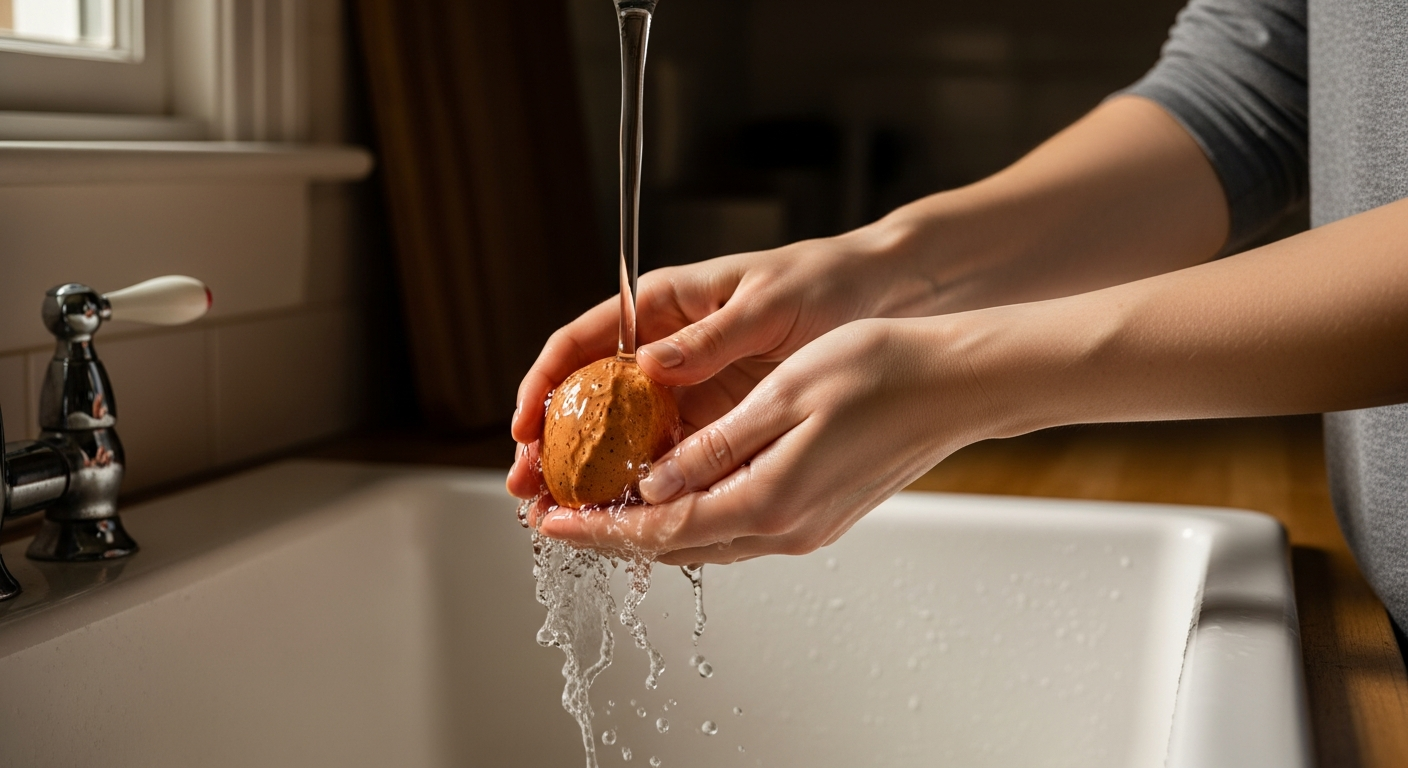
The process is simple, but getting the temperature right is the most important part.
- Let cold eggs warm up for 10–15 minutes before washing — you want the wash water warmer than the egg, not cooler
- Pre-rinse with warm running water to loosen visible dirt
- Pump 1–2 times directly onto the egg or into a scrub brush
- Scrub gently for 5–10 seconds — the foam should cover the shell
- Rinse with warm water
- Dry with a clean towel or paper towel
- Refrigerate immediately — washing removes the bloom, so these eggs need the fridge
Pro tip: For eggs that are already clean, skip the enzyme wash entirely and use a warm water rinse alone. Saving the wash for truly dirty eggs stretches one bottle much further.
How Long Does a Bottle Last? (The Cost Per Egg Math)
A 12 oz starter bottle gives approximately 200–250 pumps at 1–2 pumps per egg. If you have 4 chickens laying daily, that's roughly 120 eggs per month — so a bottle lasts about 6–8 weeks under normal use.
At full bottle price ($15), that works out to about $0.06–$0.08 per egg. With the concentrated refill ($11 for a single refill that makes a full bottle, $20 for a 2-pack), the cost drops to roughly $0.04–$0.06 per egg. If you use the 2-pack consistently, you're looking at less than $1 a week to wash your eggs properly.
That math makes the $15 starter bottle easier to justify. The concentrated refill 2-pack is the better long-term deal once you have the bottle.
DIY Egg Wash Recipe (If You Don't Want to Buy It Yet)
If you're not ready to buy yet, there are two honest DIY options worth knowing about.
Option 1: Plain warm water. For clean-ish eggs, warm water and a soft brush is genuinely sufficient. The bloom is still removed, so refrigerate immediately after. You're not getting the enzymatic breakdown of pathogens, but for personal home use with clean eggs, this works fine.
Option 2: Warm water + white vinegar. Use 1 tablespoon of white vinegar per cup of warm water. The mild acid helps loosen organic matter and has some antimicrobial properties. Better than plain water for moderately dirty eggs, though not as effective as enzyme wash for truly caked-on mud.
What doesn't work and why:
- Cold water: Creates a pressure difference that pulls contaminants in through the open pores
- Dish soap: Penetration risk once the bloom is removed — not ideal for eggs you're giving to others
- Bleach: Damages the shell structure
The DIY options work fine for casual home use. If you're washing eggs for family members, neighbors, or a small farm stand, the enzyme wash is worth the $11 refill for the extra peace of mind.
GoodEgg Wash vs. Other Methods (Quick Comparison)
| Method | Dirty Eggs | Clean Eggs | Safety | Cost |
|---|---|---|---|---|
| Plain warm water | ⚠️ | ✅ | ✅ | Free |
| Dish soap | ✅ | ✅ | ⚠️ | Pennies |
| Vinegar + water | ✅ | ✅ | ✅ | Pennies |
| GoodEgg Wash | ✅✅ | ✅ | ✅✅ | ~$0.05/egg |
For most regular chicken keepers, GoodEgg Wash hits the sweet spot. It's not mandatory — warm water handles clean eggs just fine. But for dirty-egg days, it's the easiest upgrade I've made to my egg-collecting routine.

Frequently Asked Questions
What is GoodEgg Wash? GoodEgg Wash is an enzyme-based egg cleaner made by GoodEggStuff, designed for cleaning farm fresh backyard chicken eggs. It uses plant-derived enzymes to break down organic contaminants without penetrating the eggshell the way soap can. It appeared on Shark Tank Season 16.
Is GoodEgg Wash worth it? For regular egg washers, yes — at around $0.05 per egg with the refill, it's inexpensive peace of mind. The enzyme formula is genuinely better than soap for dirty eggs and doesn't carry the shell-penetration risk. If most of your eggs come in already clean, plain warm water handles them fine.
Can you wash backyard eggs with dish soap? You can, but it's not the safest option. Once you wash off the bloom, the eggshell's pores are open — and soap can seep in, especially if you use water that's too cold. Enzyme wash and warm water is a safer combination for eggs you're sharing with family or giving away.
Should you wash farm fresh eggs or leave the bloom on? If the eggs are clean, leave the bloom on and store at room temperature for up to two weeks. If they're dirty, wash with warm water or enzyme wash — but refrigerate immediately after, since washing removes the bloom.
How do you use GoodEgg Wash? Pre-rinse with warm water, pump 1–2 times onto the egg or into a brush, scrub gently for 5–10 seconds, rinse with warm water, dry, and refrigerate. Always use water warmer than the egg — cold water can pull bacteria in through the open pores.
Did GoodEgg Wash get a deal on Shark Tank? GoodEgg Wash appeared on Shark Tank Season 16. For the current deal outcome, check GoodEggStuff.co or recent coverage — Shark Tank deals sometimes change after the episode airs.