Pine Tar Salve Recipe — The Old-Fashioned Drawing Salve That Actually Works
Last updated March 13, 2026
Quick Snapshot
What it is An old-fashioned drawing salve with 2,000 years of documented use Primary uses Splinters, boils, infections, eczema, psoriasis, bug bites Core ratio 1/4 cup infused oil + 1/2 tbsp pine tar + 1–2 tsp beeswax Boost 1/4 tsp activated charcoal + optional 1 tsp castor oil Yield ~2 oz (fills one small glass jar) Shelf life ~1 year
My grandmother kept a small tin of drawing salve in her medicine cabinet. It was dark brown, smelled like smoke, and she reached for it every time one of us had a splinter we couldn't get out. I spent years trying to find the same thing and finally realized: I could just make it.
Pine tar salve is one of those old-fashioned remedies that fell out of fashion when modern medicine arrived, and is now quietly making a comeback among people who'd rather reach for something that's been working for two thousand years than for another tube of antibiotic ointment. Here's how to make it, what it actually does, and the one ingredient sourcing tip that most recipes skip over.
What Pine Tar Salve Does — And Why It Actually Works
Yes — pine tar is a genuine drawing salve. It pulls foreign matter toward the skin surface: splinters, thorns, insect venom, and the debris from infections and boils. That's not folk tale; that's documented chemistry.
Pine tar has four active properties confirmed by clinical research: it's antibacterial (the resin acids in pine tar are bacteriostatic, meaning they inhibit bacterial growth), antifungal (acetovanillone derivatives target fungal activity), antipruritic (it relieves itching), and antiproliferative (it slows the excess skin cell production that drives psoriasis). These aren't marketing claims — they come from peer-reviewed research, including a 2016 review published in the Australasian Journal of Dermatology that analyzed 25+ years of clinical data.
People use pine tar salve for: drawing out splinters, thorns, and stingers; treating early infections, boils, and cysts; managing eczema and psoriasis flares; soothing bug bites; and relieving the itch of dry, irritated, or flaky skin.
One important clarification: pine tar is NOT coal tar. Coal tar is a byproduct of coal processing and has documented photosensitivity and carcinogenicity concerns. Pine tar is distilled from pine wood and has a different chemical profile entirely. The 25-year clinical studies on pine tar show no evidence of carcinogenicity or phototoxicity. If you've seen warnings about coal tar in shampoos or psoriasis treatments, those don't apply here.
What You Need to Make Pine Tar Salve
Pine Tar — Buy the Right Kind
This is the most important thing I can tell you before you make this recipe: not all pine tar is safe for skin use.
Feed stores and hardware stores sell pine tar as a hoof treatment for horses. This product is formulated for animal hooves — not human skin. It may contain impurities or be produced by a method (open-kiln distillation) that yields a less refined product.
For a skin salve, you want body-safe pine tar produced using a closed-kiln method. The most recommended brand among natural soapmakers and herbalists is Auson, a Swedish company that produces organic pine tar specifically for body care. It's available on Amazon and through specialty herbal suppliers. It's more expensive than feed-store pine tar — expect to pay more per ounce — but the quality and purity difference is meaningful when you're applying it to skin.
Pine tar smells strongly of wood smoke. This is completely normal and expected. The scent fades considerably once the salve absorbs into skin.
The Other Ingredients
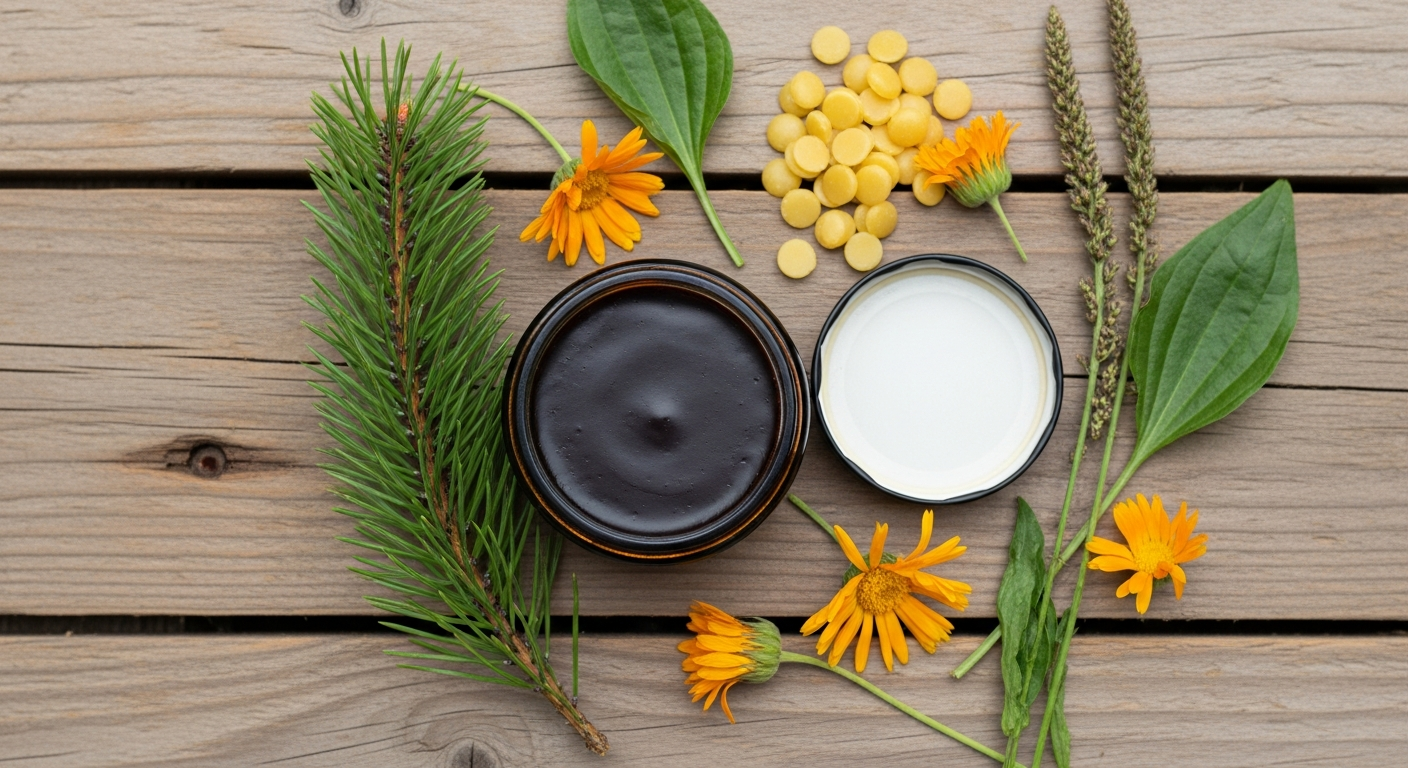
Herb-infused oil (1/4 cup) — Plantain and calendula are the classic combination for a drawing salve. Both have their own anti-inflammatory and skin-healing properties that complement the pine tar. If you don't want to infuse oil ahead of time, plain olive oil works fine for a first batch — the pine tar does most of the work.
Beeswax pellets (1–2 tsp for a soft salve; up to 1/2 oz for firmer) — Sets the salve. Use more beeswax if you want a firmer texture that travels well; less if you prefer a softer, more balm-like consistency.
Activated charcoal (1/4 tsp) — This one deserves an explanation because every recipe includes it but nobody says why. Activated charcoal is used clinically to adsorb toxins and particles at a molecular level — it's used in emergency medicine for exactly this reason. In drawing salve, it works alongside the pine tar to enhance the extraction of foreign matter at the skin surface. It also gives the salve its characteristic dark color. Capsule form is easiest to measure; just open the capsule and use the powder inside.
Castor oil (1 tsp, optional) — Two purposes: castor oil is a natural humectant (draws moisture to the skin) and is believed to enhance drawing action. Worth including if you have it.
Pine Tar Salve Recipe
Step 1 — Prepare Your Infused Oil (Or Skip to Step 2)
Quick method (2–3 hours): Place dried plantain leaf and dried calendula flowers in a heatproof jar. Cover completely with olive oil, making sure all plant material is submerged. Set the jar in a saucepan of water over the lowest heat (or a slow cooker on "keep warm"). Keep the temperature below 150°F and infuse for 2–3 hours. Strain through cheesecloth, squeezing the herbs to extract all the oil.
Cold infusion (4–6 weeks): Fill a jar loosely with dried herbs, cover with oil, lid on, store in a cool dark place, agitate weekly. Strain when ready.
Skip it entirely: For a first batch, plain olive oil or sunflower oil is a perfectly acceptable base. The pine tar carries the main medicinal action.
Step 2 — Make the Salve
Ingredients:
- 1/4 cup herb-infused oil (or plain olive/sunflower oil)
- 1/2 tablespoon pine tar (body-safe, Auson brand recommended)
- 1–2 teaspoons beeswax pellets
- 1/4 teaspoon activated charcoal (from capsules or powder)
- 1 teaspoon castor oil (optional)
Instructions:
- Line your work surface with wax paper. Pine tar stains — protect your counters.
- Combine the oil and beeswax pellets in a double boiler over low heat. Stir until the beeswax is fully melted.
- Add the pine tar and stir until completely incorporated. The mixture will turn dark brown.
- Remove from heat. Stir in the activated charcoal and castor oil (if using).
- Spoon test: Drop a small amount onto a cold metal spoon and wait 30 seconds. If it's softer than you want, return to heat and add a little more beeswax. If too firm, add a splash more oil.
- Pour immediately into a glass jar — see storage note below.
Yield: Approximately 2 oz — fills one small glass jar.
Cleanup: Pine tar is sticky and doesn't wash out easily. Use an old tin can or a mason jar lid as your primary mixing vessel so you can toss or simply wipe and reuse without destroying a pot. Let any residue dry and peel off.
Store in glass only. Pine tar has a drawing nature — over time, it can leach compounds from metal tins or plastic containers. Always store pine tar salve in glass. Standard 1-oz or 2-oz glass jars work well and are inexpensive.
How to Use Pine Tar Salve
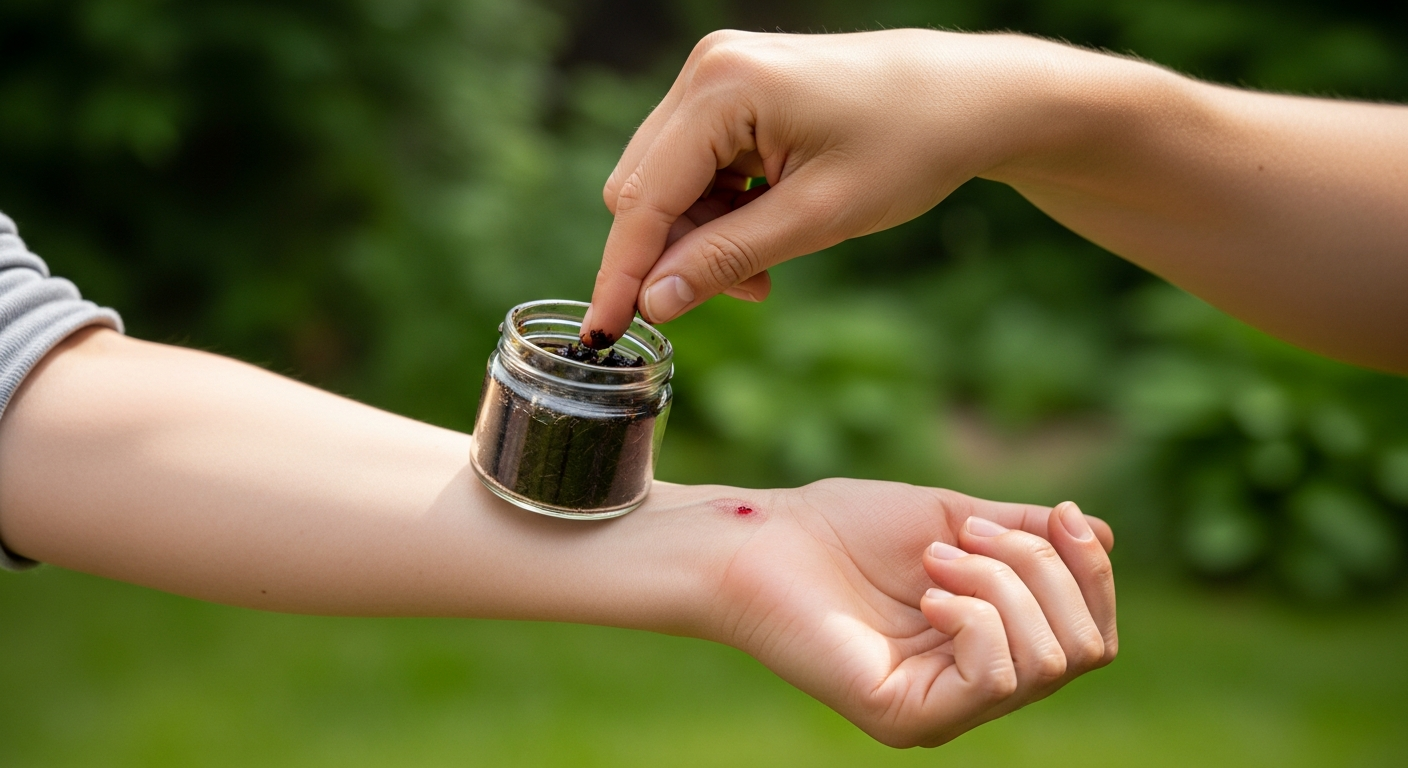
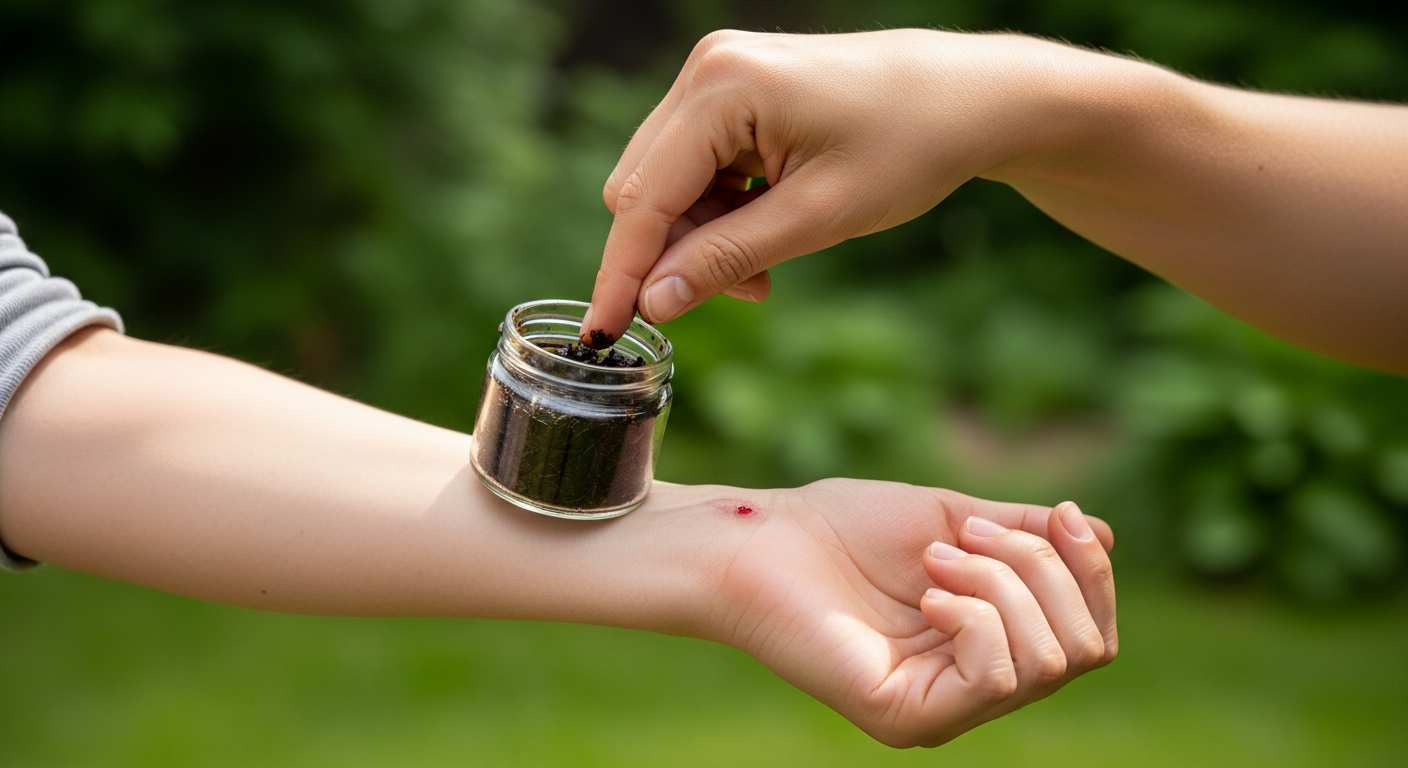
For splinters, thorns, and boils: Apply a small amount directly over the area and cover with a bandage. Leave it on for at least 6 hours — overnight is ideal. Drawing salves work under occlusion (covered). When you remove the bandage, the splinter or impurity is often visible at the surface or may have already worked its way out. For stubborn splinters, you may need a second application.
For eczema and psoriasis: Apply a thin layer to affected areas once or twice daily. The antiproliferative action targets the excess cell production that drives psoriasis; the antipruritic and anti-inflammatory properties address eczema's itch and inflammation cycle. A little goes a long way — this is a concentrated product. Start with once daily on a small area and assess your skin's response before applying more broadly.
For bug bites and minor skin irritation: A small dab applied directly to the bite relieves itch quickly. No bandage needed unless the bite is particularly severe.
Staining: Pine tar stains fabric and is very difficult to remove. Use old clothing, towels, or linens when applying to large areas.
Scent: Expect a strong wood-smoke aroma. This is normal and fades significantly as the salve absorbs.
How Long Does Pine Tar Salve Last?
About one year stored in a cool, dark location in a sealed glass jar. Pine tar itself is quite shelf-stable — degradation usually comes from the carrier oil going rancid first. The sniff test is your best guide: fresh pine tar salve smells like clean wood smoke. If it starts to smell like stale cooking oil or crayons, it's time to make a new batch.
Frequently Asked Questions
Is pine tar the same as coal tar? Is it safe? No — they're completely different products from different sources. Coal tar is a byproduct of coal processing and carries documented photosensitivity and carcinogenicity concerns, which is why you see warnings on coal tar shampoos. Pine tar is distilled from pine wood and has a much cleaner safety record. Clinical studies over 25+ years show no evidence of carcinogenicity or phototoxicity with pine tar. The safety concerns associated with coal tar do not apply to pine tar.
Does pine tar salve work for splinters? Yes, and this is what it's best known for. Apply a small amount over the splinter, cover with a bandage, and leave it for 6 hours or overnight. The pine tar draws the splinter toward the skin surface. In many cases, the splinter is visible or protruding when you remove the bandage — or it has already worked its way out. Works on thorns, cactus spines, insect stingers, and other embedded debris too.
Can I use pine tar salve on children? Pine tar at low concentrations — as found in a homemade salve — has been used on children for generations. For occasional use on bug bites and splinters, a lightly-made pine tar salve is generally considered safe for older children. For babies and toddlers, skip the activated charcoal and essential oil additions if any, and use a very small amount. As always, test on a small patch of skin first and check with your pediatrician if you have any concerns.
Can I use pine tar salve on eczema every day? Many people do, particularly during flares. Pine tar is one of the few traditional remedies with clinical evidence for eczema. Start with once daily on a small area to assess tolerance — some skin types find pine tar drying with heavy use. Pairing it with a plain moisturizer helps. For severe or infected eczema, check with your dermatologist before relying on a homemade preparation.
Where do I buy pine tar for skin use? Look for body-safe pine tar, not the feed/hoof tar sold at farm supply stores. Auson brand (Swedish, organic, closed-kiln production) is the most widely recommended for skin preparations among natural soapmakers and herbalists. It's available on Amazon and through specialty herbal suppliers. Expect to pay more than for feed-store pine tar — the quality difference matters when you're applying it to skin.
What does activated charcoal do in drawing salve? Activated charcoal binds to toxins, particles, and impurities at a molecular level — this is why it's used in emergency medicine for poisoning treatment. In drawing salve, it works alongside the pine tar to enhance the extraction of foreign matter at the skin surface, amplifying the drawing action. It also gives the salve its characteristic very dark color. You can find it in capsule form at most health food stores or on Amazon; just open the capsules and use the powder inside.