What Is a Goat Door? Pop Door Sizes, Styles, and the Best Options for Your Goat Shed
Last updated March 13, 2026
If you're doing the barn chore shuffle twice a day — propping the big shed door open in the morning, closing it back up at night — a goat pop door will change your routine immediately. It's the same concept as a chicken coop pop door, just sized up: a small goat-sized opening in your shed wall that lets your goats come and go freely without you having to manage the main door every time.
(And if you found this article looking for the Monty Hall probability puzzle — that's the other kind of goat door, and you want a different tab entirely. This one is about actual goats and actual shelters.)
Here's the quick version if you just need to pick an option:
| Door Type | Best For | Cost | DIY? | Use This If… |
|---|---|---|---|---|
| Manual swing or lift door | Most homesteaders | ~$20–40 | Yes | You want simple and cheap |
| XL dog door / flap | Small breeds (Nigerian Dwarf, Pygmy) | ~$60–150 | No (buy) | You want zero daily effort |
| Automatic timer door | Hands-off routine | ~$100–300 | Partial | You hate early morning farm chores |
Not sure which one fits your setup? Keep reading.
What Is a Goat Door (or Goat Pop Door)?
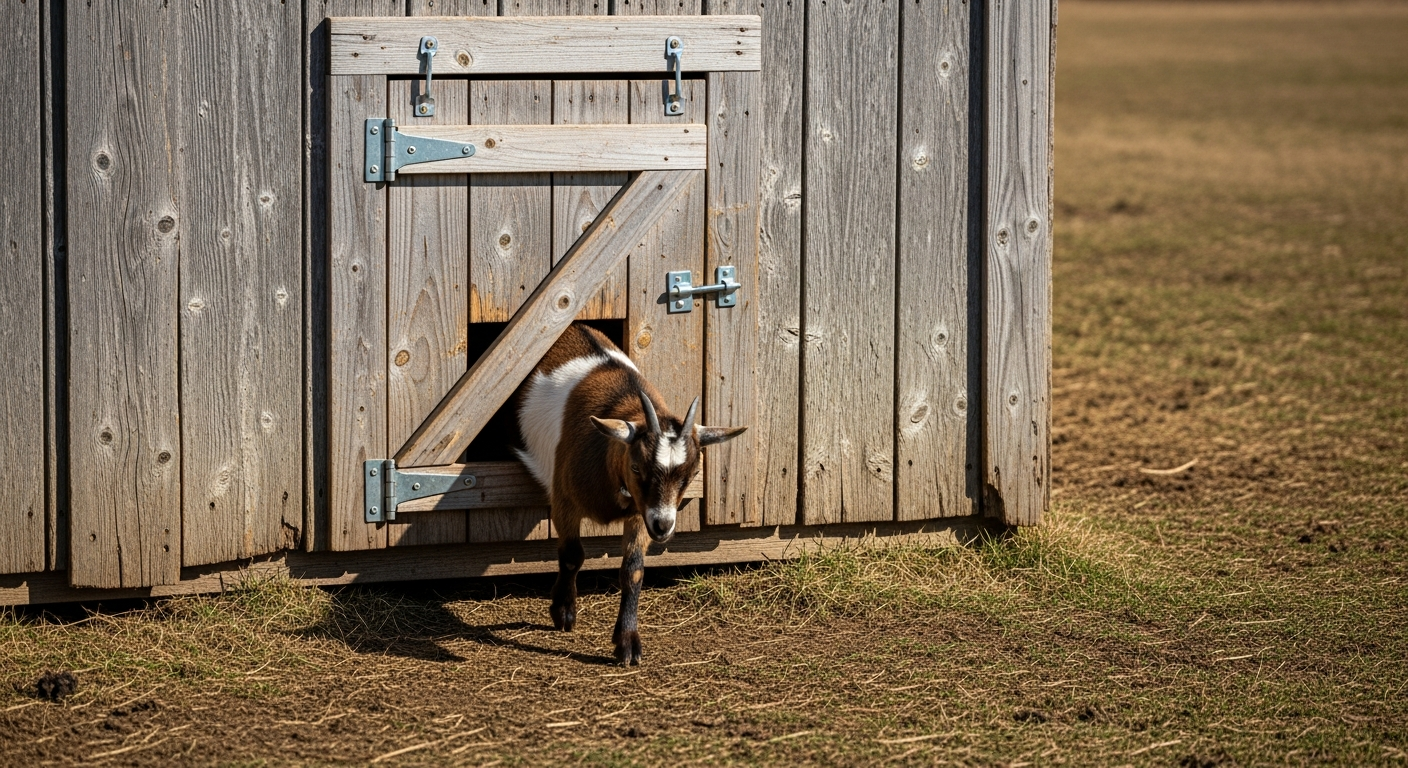
A goat door — sometimes called a goat pop door — is a small, goat-sized opening cut into the wall or door of a goat shed or barn. It lets goats come and go freely without the homesteader having to open the main people door. Think of it as the goat version of a chicken coop pop door, just sized up.
The practical case for having one is simple: if you use the main people door every morning to let your goats out and every evening to close them back in, that door is constantly getting banged around, propped open in wind, and left ajar by accident. A dedicated goat door gives the goats their own entrance and keeps your main shed door out of the daily traffic pattern. In winter especially, it makes a real difference — you're not swinging open a big door and letting all the heat out every morning.
What Size Does a Goat Door Need to Be?
A goat door should be wide enough for your largest goat to walk through comfortably with about 3–4 inches of clearance on each side. A door that's too snug means your goats will hesitate at the entrance, scratch themselves going through, or — if they're the stubborn type — just refuse it entirely.
Here's a sizing guide by breed:
| Goat breed | Minimum door width | Minimum door height |
|---|---|---|
| Nigerian Dwarf | 12" | 18" |
| Pygmy | 14" | 20" |
| Standard breeds (Nubian, Alpine, LaMancha) | 18" | 24" |
| Boer / large meat breeds | 24" | 36" |
One thing worth noting: size your door for the largest adult in your herd, not the smallest. If you have a mix of Nigerian Dwarfs and one big Nubian doe, build for the Nubian. Kids will use whatever opening the adults use, and a door that's too small for any one animal in your herd will cause problems every single day.
When in doubt, go slightly bigger. An extra inch of clearance costs nothing and prevents a lot of frustration.
4 Types of Goat Doors (And How to Choose)
There are four main options for how a goat door opens, and each has a different best-use case. Here's what to know about each one.
1. Swing-Out Door (Hinged)
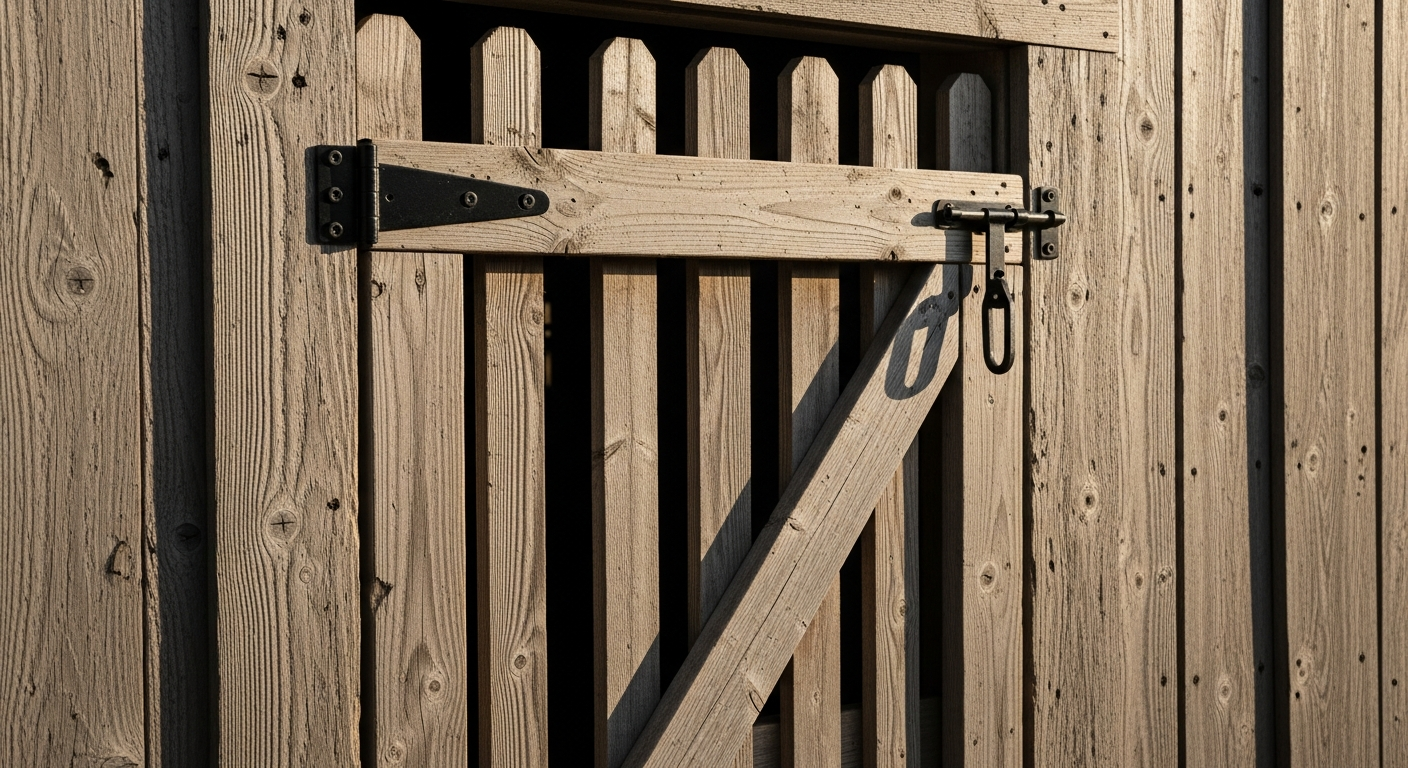
This is the most common style and what most people build. The door is hinged on one side and swings out into the pasture. You hang it with two or three T-hinges, add a gate latch, and you're done.
One important hardware note: use a gate latch with a sliding bolt, not a spring-loaded latch. Goats figure out spring latches faster than you'd expect — they'll bump and push until it gives. A sliding bolt stays put. The swing-out door is the easiest to build, the cheapest, and the most forgiving for beginners. The main downside is that it can catch in wind if you leave it propped open, so you'll want a hook-and-eye or door stop to hold it open during the day.
2. Lift-Up (Top-Hinged) Door
This style is hinged at the top and props open upward, like a little awning. You use a chain or hook-and-eye to hold it up during the day. When it's propped open, the door acts as a small roof or rain shield over the opening — which is a genuinely useful feature in rainy weather or if your shed doesn't have an overhang.
It's slightly more awkward to prop and release than a swing-out door, but the built-in weather protection is a nice bonus. Works best for sheds that have a covered porch or roof extension the door can shelter under.
3. Guillotine / Slide-Up Door
This style slides straight up in channels or guides on either side of the opening, like a tiny garage door. When it's fully closed, it drops down into the frame with no gap — making it the most predator-proof of the manual options. When you pull it up, you pin or hook it at the top.
It takes more carpentry to build correctly (the side guides need to be aligned and smooth), but if you have predator pressure, the drop-down closure is worth the extra work. It's also the only style that's compatible with an automatic door opener, since the motor simply pulls the door up along the guides on a timer. More on that in the next section.
4. Dog Door / Flap
An XL or XXL dog door with a rubber flap is a legitimate option for small goat breeds — and once your goats learn to use it, it's genuinely hands-off. The flap closes on its own, which means no daily operation, no forgetting to open it in the morning, and better draft control in winter.
Look for a door with at least a 16"×24" opening for Nigerian Dwarfs or Pygmies. Training takes a few days: push the flap open yourself, toss a treat through to the other side, and your goats will figure it out. Most learn within two or three days. The honest limitation: standard and large breeds (Nubian, Boer) need openings larger than most commercial dog doors provide. And in high-predator areas, the flap can be pushed open from the outside — so use a secondary latch at night.
Will an XL Dog Door Work for Goats?
Yes, goats will go through a dog door if it's sized correctly for their breed. Extra-large dog doors work well for Nigerian Dwarfs and Pygmy goats. Standard and large breeds need larger openings than most dog doors provide. Goats usually learn to use the flap within a few days.
The self-closing nature of a dog door flap is one of its best features for a goat setup — no drafts coming through an open doorway all winter. The downsides are the size limitations and the fact that the flap can be pushed open from the outside by a determined predator. If you use a dog door as your main goat door, add a separate exterior latch or panel you can secure at night before closing up the shed. During the day, the flap is fine on its own.
Should You Get an Automatic Goat Door?
An automatic door opener works on a timer or light sensor — the door opens in the morning at the time you set, and closes again at dusk or whenever you program it. The appeal is obvious: no 5:30 a.m. barn chores in January, and your goats are automatically locked in at night without you having to remember.
The most important thing to know before buying: most automatic door openers sold for farm animals are designed for chicken pop doors, with opening sizes around 10"×16". That's perfect for Nigerian Dwarfs and Pygmies, but way too small for standard or large goat breeds.
For larger goats, an automatic setup is a DIY project. The basic approach: build a guillotine-style door, then connect it to a small linear actuator or a winch on an outlet timer. You can put together this setup for $50–150 in parts, and it works well once it's dialed in — but it's not a plug-and-play purchase.
For small goat breeds, a standard chicken coop automatic door opener is a genuinely good investment. Look for one with both a light sensor option and a manual timer backup — the light sensor handles daylight savings automatically, and the timer backup is useful during cloudy stretches when the sensor timing gets erratic.
How to Add a Goat Pop Door to Your Existing Shed
You don't need to tear apart your whole shed — you're just cutting a goat-sized hole in an existing wall and hanging a simple door. Most people can do this in a few hours on a weekend afternoon.
Before you start:
- Know your goat breed and the minimum opening size (see sizing table above)
- Check where wall studs are — cut between studs, not through them (use a stud finder or knock along the wall and listen for the solid spots)
- Have on hand: reciprocating saw or jigsaw, 2×4 scraps, T-hinges, sliding gate latch
Steps:
- Mark your opening with chalk, adding about 1 inch beyond the minimum dimension on each side
- Cut the opening with a reciprocating saw (cut between studs)
- Frame the inside of the opening with 2×4 scraps — this gives you something solid to hang hinges from and makes the whole thing look clean
- Build a simple door: fence pickets cut to size and attached to a basic 2×4 frame, or use a piece of 3/4" plywood cut to size
- Hang on 2–3 T-hinges; add a sliding gate latch on the pasture side
- Optional: add a rubber door sweep at the bottom to cut down on drafts and rodent entry
That's it. It's not a major carpentry project. If you want a full cut list and detailed build plans, The Inspired Workshop has an excellent tutorial for goat shed doors that goes much deeper on the construction details.
How to Keep Goats Out of Your Chicken Pop Door
If you have both goats and chickens, you've probably encountered this from the other direction: goats squeezing into the chicken coop to steal feed. Goats will push through any chicken pop door that's big enough for a large-breed hen, and once they figure out there's feed inside, they will not stop trying.
Three solutions that actually work:
1. Size down the chicken pop door. A 10"×12" opening is enough for most standard chicken breeds but too small for most goats. If you have very large hens (Brahmas, Jersey Giants), you may need to go to 12"×14" — which creates a challenge. That leads to option two.
2. Raise the opening off the ground. Mount the chicken pop door 8–10 inches up from the floor instead of at ground level. Chickens hop right up; goats rarely bother crouching down and crawling through an elevated opening. I did this with our setup and the goats completely lost interest within a day.
3. Add a short tunnel. Attach a 12"–18" horizontal tunnel extension to the outside of the pop door opening. Chickens walk through easily; goats won't bother crawling through a tunnel to get to the other side. More work to build, but effective for persistent goats.
FAQ — Goat Pop Door
What is a goat pop door? A goat pop door is a small, goat-sized opening in a shelter wall or door that lets goats come and go freely without requiring the homesteader to open the full-sized door. It's the livestock equivalent of a dog door or chicken coop pop door, just scaled up for goats.
Will goats go through a dog door? Yes — most goats will learn to use an XL or XXL dog door within a few days. It works best for small breeds like Nigerian Dwarfs and Pygmies. Standard and large breeds (Nubian, Boer) need openings larger than most commercially available dog doors provide.
What size should a goat door be? Nigerian Dwarfs need a minimum of 12"×18"; Pygmies need about 14"×20"; standard breeds (Nubian, Alpine, LaMancha) need 18"×24"; Boer and large breeds need 24"×36". Always size for your largest adult goat.
Do goats need a door on their shelter at night? Goats should be secured at night for protection from predators. A pop door is great for daytime access, but you need a way to close and latch it in the evening — either manually or with an automatic closer. An open doorway at night is an open invitation for predators.
How do I keep goats out of my chicken coop? Size the chicken pop door to 10"×12" or smaller, raise the opening 8–10 inches off the ground, or add a short horizontal tunnel extension. Most goats won't bother with a small, raised opening.
Can I use a chicken coop automatic door opener for goats? Only for small breeds. Most chicken automatic door openers are designed for 10"×16" openings — fine for Nigerian Dwarfs and Pygmies, but too small for standard or large goat breeds. For larger breeds, a DIY automatic setup using a guillotine door and linear actuator is the way to go.
How do you keep goats from pushing a door open? Use a sliding bolt gate latch instead of a spring-loaded latch — goats learn to bump spring latches open surprisingly fast. For guillotine-style doors, a simple drop pin or bolt at the bottom of the door frame keeps it firmly closed even against a persistent pusher.