How to Keep Chickens Off the Porch (What Actually Works in 2026)
Last updated March 11, 2026
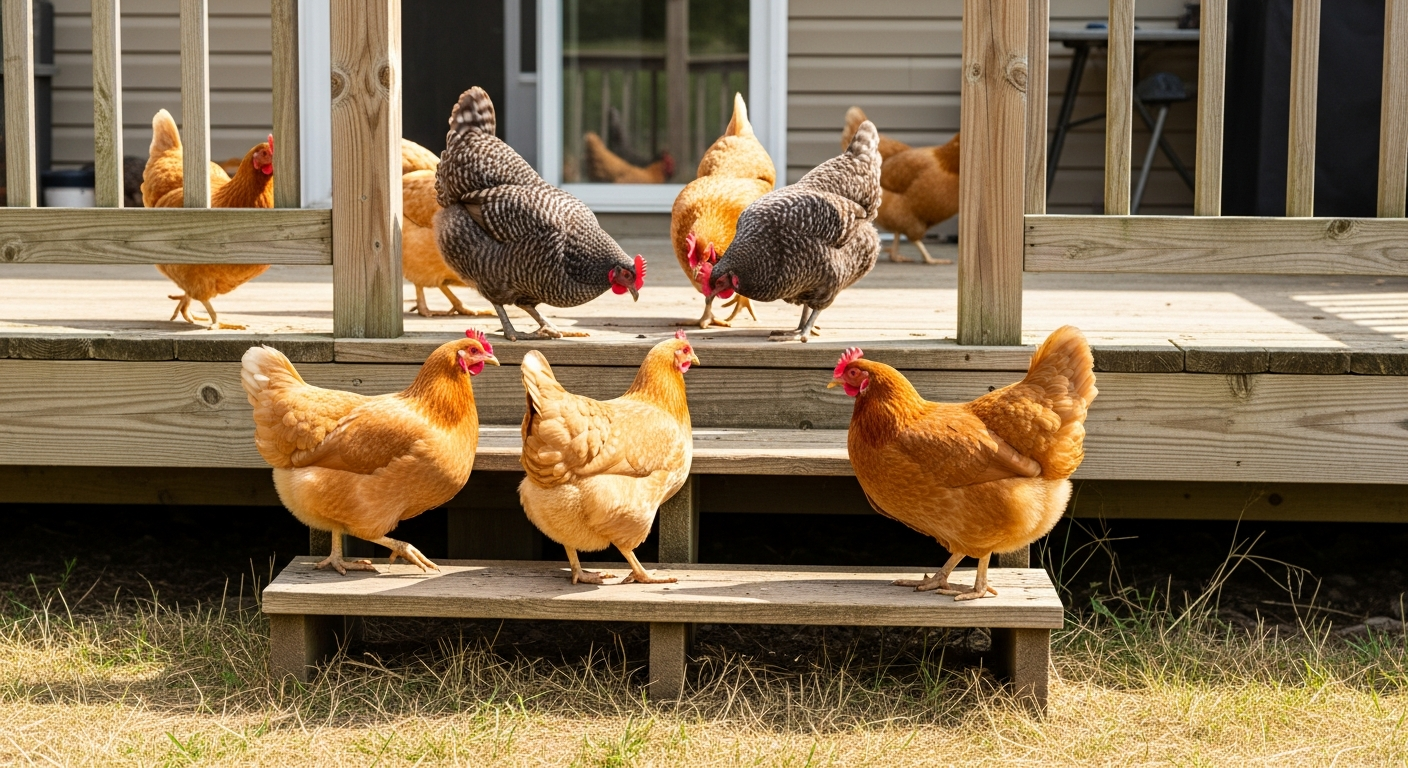
If your free-range chickens have claimed your porch as their personal hangout spot, you're not alone. I've been there — stepping out the back door barefoot and immediately regretting every chicken-related decision I've ever made. The good news is that this is a solvable problem, and you don't have to confine your flock to fix it.
Here's what actually works.
Quick Answer: The Fastest Fixes
- Move feeding stations away from the porch — that's the #1 reason they keep coming back
- Scatter citrus peels or strong herbs (lavender, catnip, sage) around the porch perimeter — free and more effective than you'd expect
- A motion-activated sprinkler (~$35) is the best hands-free solution — works 24/7 without you being there
- Stop casually shooing them — inconsistent reactions don't teach chickens anything
Why Chickens Love Your Porch (And Why That Matters)
I used to wonder why my hens would ignore acres of pasture and park themselves on my back deck every single day. Turns out it's not random.
Once I understood why they kept coming back, the fixes became a lot more obvious. Chickens are drawn to your porch for a few predictable reasons: the porch is near their coop, so it's naturally in their daily roaming territory. Elevated surfaces — porch railings, steps, deck furniture — are irresistible to chickens because height equals safety in their instincts. And if you've ever given them treats or scraps near the back door, you've trained them that "humans near the house = food is coming."
The porch also offers shade from the sun, shelter from rain, and protection from the wind. Honestly, chickens appreciate the same comforts we do.
Once I realized I was partially the problem — I'd been tossing them scratch grain near the back step every morning — it became an easy fix.
Free Methods: Try These First
You probably already have everything you need to try these. I always start with free before spending money.
Move Your Feeding Area Away From the House
This one thing made the biggest difference for me. Chickens are wired to return to where food comes from — it's not stubbornness, it's just how they operate. If feeding, watering, and treat-giving all happen in the coop area (not near the house), they'll start associating the coop area with food rather than your porch.
Move feeders, waterers, and treat-giving entirely to the coop or a designated far area of your yard. This means no more tossing scraps near the back door, no matter how convenient it is. Also check your bird feeders — spilled seed near the porch is a constant invitation. Relocate them to the far side of the yard, or take them down temporarily until the porch habit breaks.
This works faster than most people expect, usually within 1-2 weeks of consistent follow-through.
Water Spray Training
A garden hose or spray bottle can teach chickens to avoid the porch — but only if you do it every single time and within about 30 seconds of them showing up. Without that consistency, chickens don't make the connection between the porch and the unpleasant outcome.
Use a light stream — the goal is to startle, not hurt. Direct it toward them, and they'll scatter immediately. The limitation is obvious: you have to be home and paying attention. For an automated version of this, skip ahead to the motion-activated sprinkler section.
Citrus Peels and Strong-Smelling Herbs
Chickens have sensitive smell receptors and genuinely dislike certain strong scents. This is a completely free deterrent if you cook with citrus or grow herbs.
Scatter lemon, lime, or orange peels around the porch perimeter. Refresh every 3-5 days, or after rain washes the scent away. Dried herbs also work well — sprinkle catnip, sage, marjoram, or chives along the porch edge and reapply weekly. Coffee grounds are another option that works on the same principle.
For a longer-lasting solution, plant fresh herbs directly in pots near the porch. Lavender, mint, and lemon balm work especially well because they grow back and release scent continuously. It has the added benefit of making your porch smell like a garden instead of a barnyard.
Create a Better Option Elsewhere
The most underused free method is also the most effective long-term: make somewhere else more attractive than your porch.
Chickens aren't coming to the porch because they hate the yard — the porch is just currently winning the competition. Give them a designated area far from the house with: a bare patch of ground for dust bathing (they love this), scratch grain scattered consistently, an old log for pecking, or a hanging treat like half a cabbage or a melon chunk. The more interesting you make their area, the less interesting your porch becomes.
Low-Cost Solutions ($10–$60): The Easy Button Options
If the free methods aren't cutting it, these are worth the small investment.
Motion-Activated Sprinkler — The Best Set-and-Forget Option
This is probably the easiest solution if you just want the problem gone without having to think about it. A motion-activated sprinkler connects to your garden hose, detects movement within its range, and shoots a burst of water at whatever triggered it. Set it at the entry point to your porch — the stairs, the deck edge, wherever the chickens come in — and it handles the rest.
The biggest advantage over manual water spray is that it works around the clock without you being present. You don't have to catch them in the act. It also works on deer, raccoons, the neighbor's cat, and anything else that wanders across your porch at 2am. Most models run $30–$50 and connect to any standard hose.
Fake Predator Decoys (Only If You Move Them)
A plastic owl or hawk can work — but only if you commit to moving it every 2-3 days to a new location. Chickens are smarter than we give them credit for, and a stationary fake predator becomes furniture within a week. They'll walk right past it.
If you rotate the decoy regularly — different corners of the porch, different heights, different orientations — it maintains the "this thing is alive and watching me" effect longer. This approach is more effective with younger or recently acquired birds than with hens who've lived through every trick in the book. Cost is typically $15-25, and it buys you one to two weeks of deterrence if you're consistent about moving it.
Simple Fencing Around the Porch Area
You don't need expensive permanent fencing to section off a porch. A few T-posts and 20-25 feet of chicken wire or lightweight garden fencing can block access to porch stairs in about 30 minutes. It doesn't need to be pretty — it just needs to make the porch inconvenient to reach.
Focus on entry points (stairs, gaps under the deck) rather than fencing the entire porch perimeter. If your chicken porch situation is more serious — large flock, persistent return even after other methods — portable electric poultry netting ($100-200) lets you create a movable exclusion zone that you can reposition as needed.
What Doesn't Work (Save Yourself the Trouble)
I've tried some of these, and I've seen them recommended everywhere. Here's what I'd skip:
CDs or shiny objects strung up. I know this gets suggested constantly. My chickens looked at them, pecked at them a few times, and then ignored them completely. I'm convinced this advice has been copied from article to article without anyone actually testing it.
Vinegar spray on porch surfaces. It works as a short-term smell deterrent, but it washes away with any rain or morning dew, and it doesn't create any lasting behavioral change in the chickens. Not worth the repeated effort.
Casual, inconsistent shooing. Walking out and waving your arms every few days does nothing. If there's no real consequence every single time, chickens don't learn the boundary. It also degrades the trust you've built with your flock.
Stationary fake predators. Covered above — they stop working within days if you don't move them. A plastic owl that's been in the same corner for two weeks is just part of the porch furniture as far as your hens are concerned.
Chickens are smart and they adapt quickly — anything static or inconsistent won't work long-term. The solutions that actually work involve either physical barriers, genuine consequences (like water), or removing the reason they're there in the first place.
If They're Roosting on Your Porch Railing at Night
Nighttime roosting on a porch railing is a different problem than daytime porch-loitering, and it needs a different solution.
Chickens start looking for roost spots 30-60 minutes before full dark. If your porch railing is higher than their coop perch and feels secure, they'll choose it. The fix: close the coop earlier in the evening, before they start hunting for alternative roost spots. If they're already settled inside when dusk approaches, they won't need the railing.
Also check that your coop roost bars are comfortable — they should be at least 18 inches off the floor and provide 8-12 inches of space per bird. Overcrowded or poorly placed roost bars push chickens to find alternatives.
For a physical deterrent on the railing itself, garden bird deterrent strips (the kind used for pigeons) work well — they're cheap, unobtrusive, and make the railing surface uncomfortable to stand on.
FAQ: Chickens on the Porch — Common Questions
What is the 90/10 rule for chickens?
The 90/10 rule comes from poultry nutritionists: 90% of a chicken's diet should be complete feed, with only 10% from treats and extras. For the porch problem, it's a useful reminder: if treats or table scraps near the house make up part of their daily routine, you're actively training them to return to that area. Keep treats for training purposes only, and give them in the designated chicken area — not near the porch.
What smells do chickens hate?
Citrus (lemon, lime, and orange peels or juice), catnip, sage, marjoram, lavender, mint, and coffee grounds. Scatter these around the perimeter of areas you want to protect. Reapply after rain since the scent dissipates with moisture.
How do I stop chickens from roosting on my porch railing at night?
Close the coop 30-60 minutes before dark, when chickens start seeking roost spots — if they're inside, they won't migrate to the railing. Make sure coop roost bars are comfortable and uncrowded. As a backup, add a physical deterrent strip along the railing top to make it uncomfortable to stand on.
Does vinegar keep chickens away from the porch?
Short-term, yes. Chickens don't love the smell of vinegar, and it'll deter them temporarily. But it washes away quickly and doesn't train any lasting behavioral change, so you'd have to reapply constantly. Citrus peels and planted herbs are more effective and require less maintenance.