Salmon Faverolle Feet: 5 Toes, Feathered Legs, and What to Do When Something Looks Off
Last updated March 12, 2026
Salmon Faverolle Feet — Quick Reference
- Standard toe count: 5 toes per foot (polydactyly gene)
- Leg feathering: fully feathered from hock to all toes
- Normal variation: 4 toes on one foot, 5 on the other — genetic, not a defect
- Show standard: 4-toed birds are disqualified (DQ'd) under APA rules
- Key health watch: bumblefoot hides under feathering — weekly foot checks matter
- Coop requirement: keep roosts at 2–4 feet max to protect the fifth toe
What Makes Salmon Faverolle Feet Unique?
I'll admit it: when I first got Faverolles, I couldn't stop staring at their feet. The fluffy feathering that runs all the way down their legs, the extra toe curling off to the side — it's one of those details that makes you look twice. Salmon Faverolles have two distinct foot traits that set them apart from most other chicken breeds, and understanding both of them makes it a lot easier to keep your birds healthy.
What Healthy Faverolle Feet Look Like
Before we get into what can go wrong, let's talk about what "normal" looks like — because if you know what you're looking for, you'll spot problems much faster.
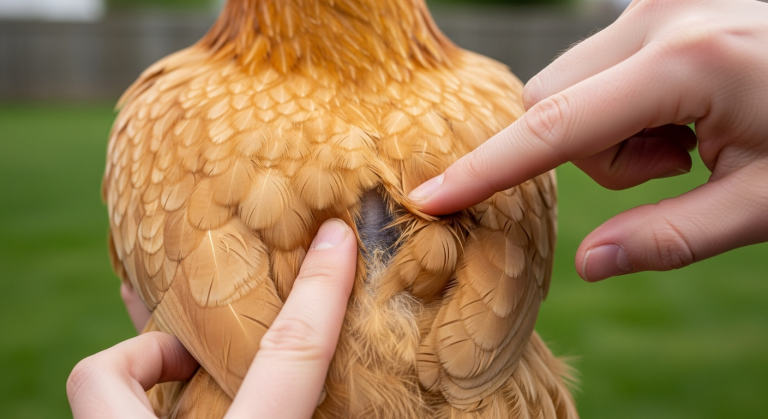
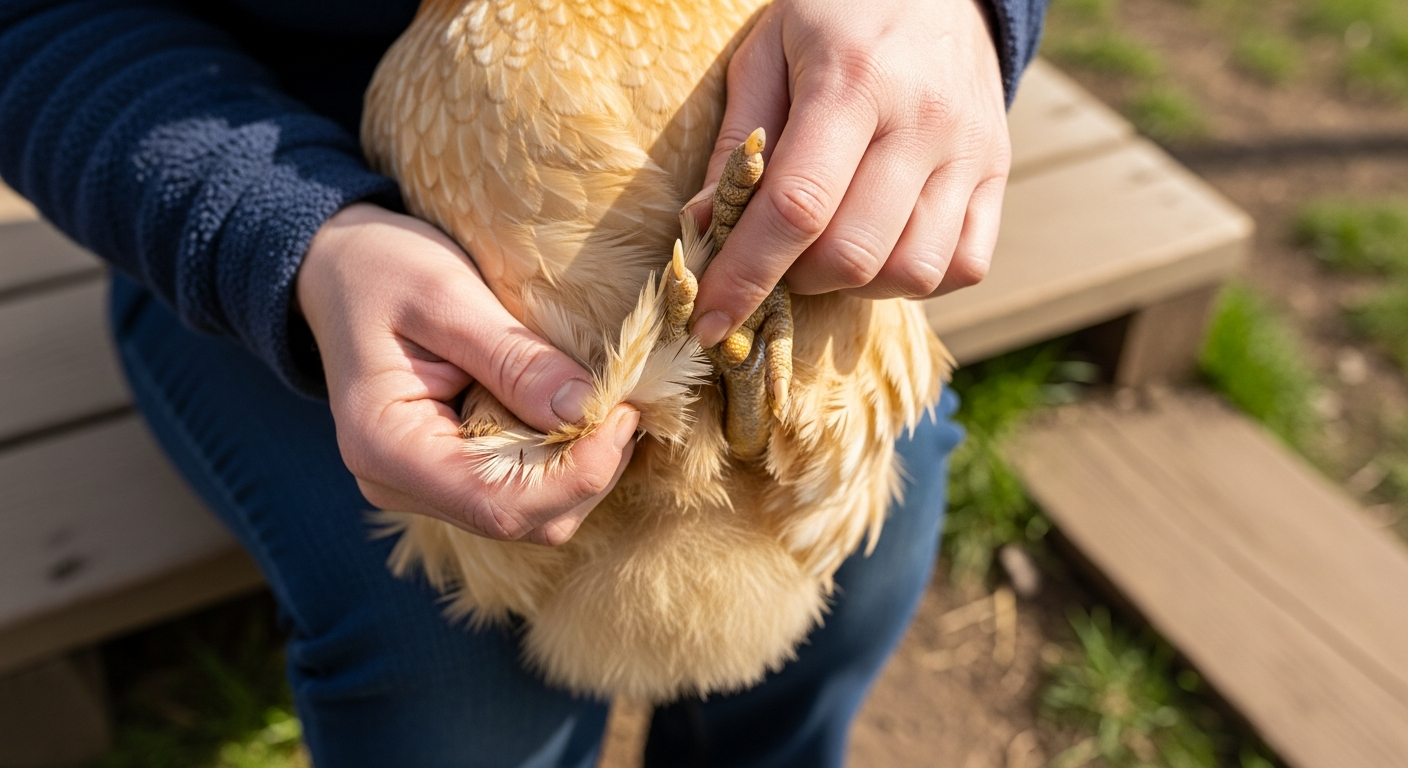
Healthy Salmon Faverolle feet have smooth scales on the front surface of the foot, five toes (four pointing forward and one extra inner toe that angles slightly back and doesn't touch the ground), and pink pads on the bottom with no dark spots, rough patches, or swelling. The legs are covered in feathering from the hock — that's the knee joint — all the way down to the toes, including the fifth one. The feathers should lie flat and clean, not matted or clumped together.
The 5-Toe Trait — Why Faverolles Have an Extra Toe
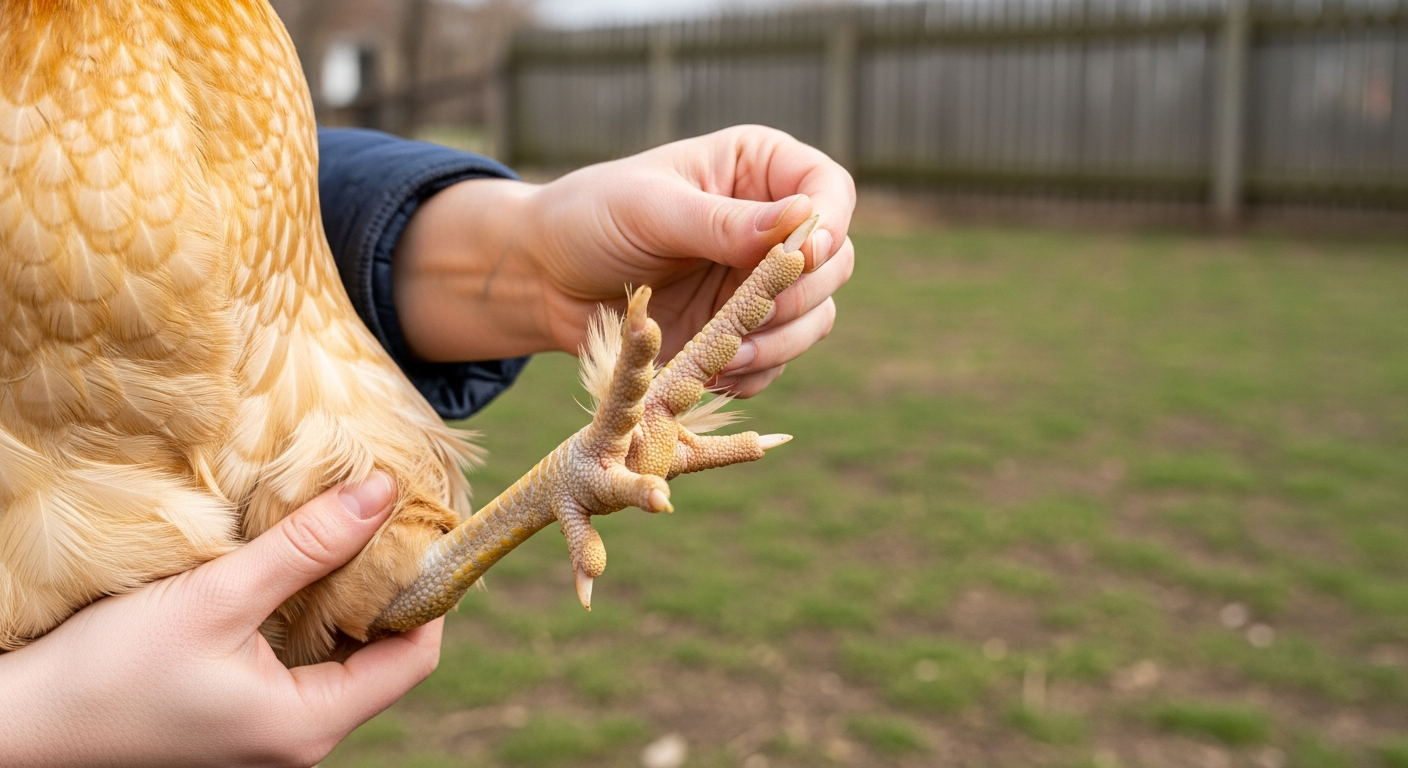
Faverolles carry the polydactyly gene — the same gene that gives Silkies, Dorkings, and Houdans their extra toe. "Polydactyly" just means extra digits, and in Faverolles it's been a defining breed characteristic since the American Poultry Association recognized them in 1914. It's not a mutation or a defect in this breed — it's intentional and part of what makes a Faverolle a Faverolle.
The fifth toe is positioned on the inner side of the foot, slightly higher than the others, and it doesn't bear any weight when your bird walks. It just sort of goes along for the ride. If you pick up your Faverolle and look at the bottom of her foot, you'll see the four normal toes plus that extra inner one set back slightly. Once you see it, it's easy to find every time.
Feathered Legs — What the Standard Requires
The breed standard requires leg feathering to run from the hock all the way down to each toe — including that fifth one. A Faverolle with clean legs or partial feathering isn't meeting the standard and won't place well in a show. It's one of those details that experienced Faverolle breeders pay close attention to when evaluating birds.
All that feathering is part of what makes Faverolles so charming and distinctive. But it does mean their feet need a little more attention than clean-legged breeds like Rhode Island Reds or Barred Rocks. Feathered legs trap moisture, mud, and debris in ways that bare legs don't — which I'll get into in the care section below.
My Faverolle Has 4 Toes on One Foot — Is That Normal?
If you're reading this at midnight worried about your chicken — take a breath. I've been there too. Here's what's going on.
Asymmetric Toe Count Is Normal for This Gene
The polydactyly gene doesn't always express the same way on both feet. It's entirely possible — and actually fairly common — for a Faverolle to have 4 toes on one foot and 5 on the other. You see the same thing happen in Silkies, which also carry the polydactyly gene. One foot gets the extra toe, the other doesn't. The gene did its thing asymmetrically, and the result is a bird who is completely healthy and otherwise perfectly normal.
Your bird with 4 toes on one foot will lay the same number of eggs, be just as friendly, and live out her full life without any issues related to her toe count. The asymmetry doesn't cause pain, doesn't affect her gait in any meaningful way, and isn't something that will worsen over time.
Does It Affect Showing or Breeding?
Two separate questions here, and the answers are different.
For showing: Yes, a 4-toed bird is a disqualification under APA standards. If you're planning to show your Faverolles, this bird won't be eligible. That's a firm rule.
For breeding: This is where it gets a little more nuanced. If you want to breed Faverolles, check the leg feathering on the 4-toe foot carefully. If the feathering doesn't extend all the way down to each toe on that foot, it's best not to breed this bird — that missing-feathering trait is hard to breed back out of a line once it's in. But if the feathering does reach all toes (even on the 4-toe foot), you can make a more informed decision.
For backyard keepers: If you're not showing and not breeding for show quality, none of this matters. Your Faverolle with the "wrong" feet is still a wonderful, healthy bird. Enjoy her.
How to Keep Salmon Faverolle Feet Healthy
Now that you know what you're working with, here's what day-to-day Faverolle foot care actually looks like. It's not complicated once you make it part of your routine — it just requires a little more intention than you'd give a clean-legged breed.
The 2-Minute Weekly Foot Check
This is the single best thing you can do for feathered-leg birds. Feathers hide early problems — a small dark spot on the pad that would be immediately visible on a bare-legged hen can go unnoticed for weeks on a Faverolle if you're not actively looking for it. A two-minute weekly check catches issues early when they're easy to address.
Here's the routine:
- Pick up your bird, or observe her while she's calm on a low roost.
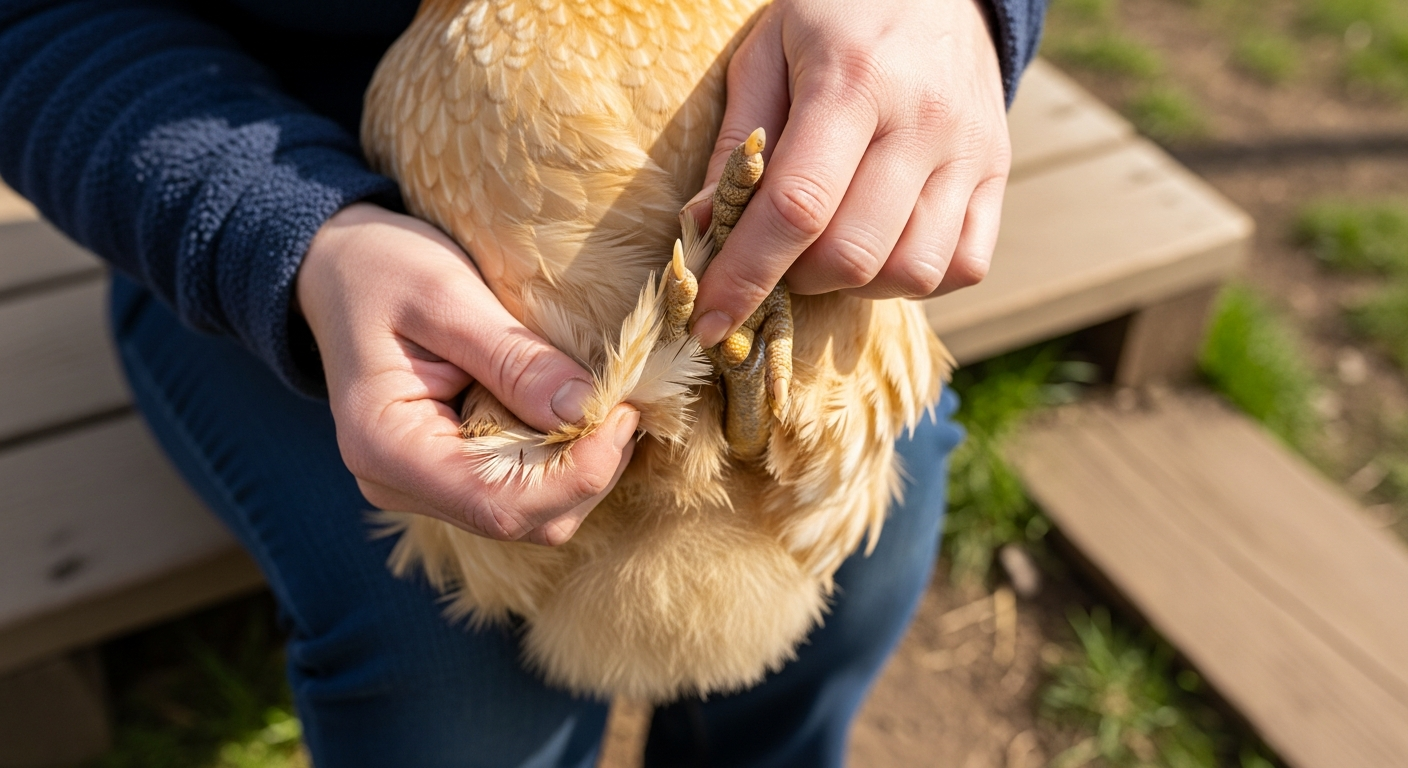
- Part the leg feathers with your fingers and look at the scales underneath — they should be smooth and clean.
- Flip the foot and check both pads for dark spots, swelling, or rough texture.
- Check each toe individually, including the fifth.
- Look for red or irritated skin between the toes.
- Check for caked mud or debris packed into the feathers near the foot.
I do mine on Sunday mornings when I'm refilling water — it takes less time than it sounds.
Why Low Roosts Matter for Faverolles
Faverolles do best with roosts set at 2 to 4 feet maximum. The reasoning is specific to this breed: when a heavy-bodied bird with feathered feet jumps down from a high roost, the impact is absorbed through the pads and toes. For most breeds, this isn't a big problem. But Faverolles have that fifth non-weight-bearing toe, which is more vulnerable to bending or catching on landing — and their feathered feet create a bit of drag that makes high-roost descents more awkward to begin with.
Most generic chicken guides give one roost height for all breeds. Faverolles are an exception. If you built your coop with 6-foot roosts for your Rhode Island Reds and then added Faverolles, it's worth adding a lower roost specifically for them.
Keeping Feathered Feet Clean and Dry
This is the thing most new Faverolle owners don't know going in: feathered legs trap moisture, mud, and bacteria in a way that bare-legged breeds don't. When those feathers stay wet or dirty for extended periods, you create conditions that invite skin irritation, bacterial buildup, and foot problems.
The practical fix isn't complicated. Use dry bedding — pine shavings work well, and the deep litter method works even better because it stays drier underneath. Avoid muddy runs where possible, especially in spring and fall. After a heavy rain, check your birds' feet for mud or wet feathering and dry them off if needed.
In winter, watch for a specific hazard: frozen mud balls that can form in the feathers near the foot. These are uncomfortable for the bird and can cause injury if they're large enough. In wet or freezing weather, check feathered feet more frequently than you would in summer. It takes about 30 extra seconds per bird and makes a real difference.
Bumblefoot in Salmon Faverolles — What to Watch For
Bumblefoot sounds alarming, but early-stage cases are very manageable at home. The key with Faverolles specifically is that the feathering hides early signs — which is exactly why the weekly foot check matters so much. Catching bumblefoot at Grade 1 (small, hard lump, no open wound) is a completely different situation than catching it at Grade 3 (significant swelling, open wound, bird visibly limping).
What Bumblefoot Looks Like (and Why It's Harder to Spot on Faverolles)
Classic bumblefoot presents as a black or dark brown scab on the pad of the foot, sometimes with puffiness or warmth around it. In early stages, it's just a small hardened spot — easy to miss on a bare-legged bird and even easier to miss on a Faverolle, because the feathers covering the foot mean you have to actively part them to see the pads.
That's the key distinction with feathered-leg breeds. On a Rhode Island Red, a foot problem is visible at a glance when she's walking around the coop. On a Faverolle, the same problem is hidden under a layer of feathers until you look. This is why weekly foot checks matter — it's not about being anxious, it's about catching things before they get serious.
Can Bumblefoot Heal on Its Own?
The short answer: sometimes, if caught at the very earliest stage. A tiny, hard bump with no open wound and a bird that's walking normally may improve on its own with a few changes — drier bedding, lower roosts to reduce foot impact, and close monitoring. Grade 1 bumblefoot, caught early, is genuinely manageable.
Anything beyond that — a larger scab, any swelling, or a bird who's favoring one foot — needs active treatment. Bumblefoot that's left alone almost always progresses rather than resolving, because the underlying infection continues without intervention. Don't wait more than a week to see if it improves on its own. If it's not clearly better, start treatment.
Home Treatment for Early Bumblefoot
I've treated early bumblefoot at home, and it's not as scary as it sounds when the case is mild. Here's the process for Grade 1 to mild Grade 2:
- Soak the foot in warm water with Epsom salt for 10 to 15 minutes daily. This softens the tissue and helps draw out infection.
- Check the scab — if it lifts easily after soaking, gently remove it. If it's not ready to come off, don't force it.
- Apply antiseptic wound spray to the pad — Vetericyn poultry wound spray is what I keep in my chicken first-aid kit and it works well for this.
- Wrap with vet wrap to keep the foot clean between treatments. A loose wrap is fine — just enough to protect the pad.
- Recheck daily and rewrap after each soak.
- If no improvement in 5 to 7 days, or if swelling increases or your bird starts limping more noticeably: call a poultry vet. Severe bumblefoot involves bone infection and needs professional treatment.
Salmon Faverolle Feet — FAQ
Do Salmon Faverolles have 5 toes?
Yes. Faverolles carry the polydactyly gene, which gives them a fifth toe on each foot. It's positioned on the inner side of the foot, angles slightly back, and doesn't touch the ground when the bird walks. This trait has been part of the breed standard since the APA recognized Faverolles in 1914.
Do Salmon Faverolles have feathered feet?
Yes. Feathering runs from the hock (knee joint) down to all five toes. This leg feathering, along with the beard, muffs, and fifth toe, is one of Faverolles' most distinctive physical traits. It's also part of the breed standard — leg feathering must reach all toes on show-quality birds.
Why does my Faverolle have 4 toes on one foot?
The polydactyly gene can express differently on each foot — 4 toes on one side and 5 on the other is a normal variation that shows up in Faverolles and other polydactyl breeds like Silkies. Your bird is healthy. She won't be eligible for showing under APA standards, but she'll live a perfectly normal life.
Can chicken bumblefoot heal on its own?
Very early-stage bumblefoot (a tiny hard bump, no open wound, bird walking normally) may improve on its own with dry bedding and lower roosts. Anything more developed needs active home treatment — Epsom salt soaks, antiseptic spray, and daily bandaging. Don't wait more than a week to see if it resolves; bumblefoot typically progresses without intervention.
How do I care for my Faverolle's feathered feet?
Weekly foot checks — part the feathers and look at the pads — plus dry bedding and roosts no higher than 2 to 4 feet. In wet weather, check more frequently for mud balls forming in the feathers near the foot, which can cause discomfort and injury if they freeze.
Do Salmon Faverolles need special roosts?
Yes — keep roosts at 2 to 4 feet maximum. Higher roosts put stress on the feet and toes during landing, and the fifth non-weight-bearing toe is particularly vulnerable to being caught or bent on impact. If you have a mixed flock with higher roosts, add a lower option specifically for your Faverolles.