What Is a Hay Load? (Plus How to Haul One Safely in a Pickup)
Last updated March 13, 2026
If you've ever wondered what people mean when they say "a load of hay" — or how on earth to haul one without bales bouncing across the highway — you're in the right place.
- A "hay load" = traditionally 21 small square bales; loosely used today to mean one truckload
- Typical small load cost: $100–750+ depending on bale type and region
- A half-ton pickup can haul: ~12–16 small square bales safely (always check your payload sticker)
- To secure it legally: 2+ ratchet straps, tightened before you leave, re-tightened after 1–2 miles
What Is a Hay Load?
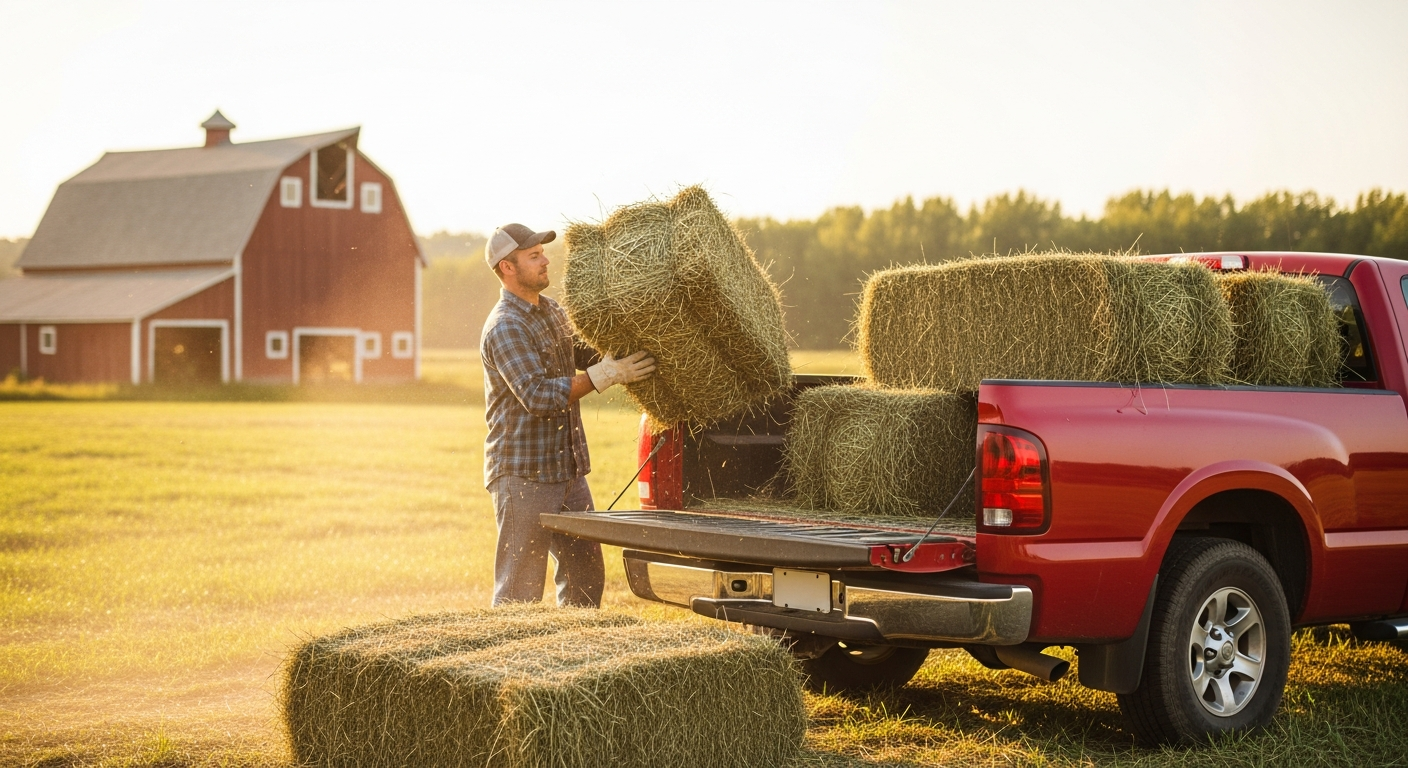
In old farm language, "a load" of hay meant 21 small square bales — that's exactly how many fit on a standard farm wagon back when that was the main way to move hay. It was as standard a measurement as a dozen eggs.
Today, the term has gotten a lot looser. When someone selling hay says "I've got a load ready," they probably mean a full trailer — not necessarily 21 bales on the nose. A "load" now generally means one trip's worth of hay, whatever that looks like given the trailer size and bale type.
If you're buying round bales, a "load" typically means 10–20 bales depending on the trailer. Round bales are much heavier than square ones (800–1,200 lbs each vs. 40–60 lbs for small squares), so a smaller number still adds up fast in both weight and cost.
How Much Does a Load of Hay Cost?
Hay prices vary a lot by region, hay type, and time of year — so treat these as starting points, not gospel. Call local farms or check your area's Facebook Marketplace to find what hay actually costs near you.
| Bale Type | Price Per Bale | Typical "Load" | Estimated Cost |
|---|---|---|---|
| Small square bales (40–60 lbs) | $5–15 | 20–50 bales | $100–750 |
| Large square bales (800–1,200 lbs) | $60–150 | 8–16 bales | $480–2,400 |
| Round bales (4×5 or 5×5, ~800–1,200 lbs) | $40–120 | 4–10 bales | $160–1,200 |
Hay type matters too — alfalfa is usually the priciest, while grass hay or mixed grass/alfalfa blends tend to be more affordable. For chickens, goats, or horses that aren't high-performance athletes, grass hay or a mixed blend is typically plenty.
One timing tip: August and September, right after the first fall cut, often have the best prices and the freshest hay in storage. Late winter is when prices creep up as supplies get tighter. If you can buy in bulk in late summer, you'll usually save money.
How Much Hay Can Your Truck Actually Haul?
Here's the thing nobody tells you when you're new to this: a truck bed full of hay weighs a lot more than it looks. Hay is dense. It's easy to overload a half-ton pickup without realizing it, which is rough on your suspension and potentially dangerous.
Before you load up, check the payload sticker on the inside of your driver's door jamb. That yellow label gives you the maximum weight your truck can carry — including passengers, gear, and your load of hay. It takes 30 seconds to check and could save your axle.
| Vehicle | Payload Capacity | Small Square Bales | Round Bales |
|---|---|---|---|
| Half-ton pickup (F-150, RAM 1500) | ~1,500–2,000 lbs | 12–16 bales | 1 max |
| 3/4 ton pickup (F-250, RAM 2500) | ~2,500–4,000 lbs | 20–30 bales | 2–3 |
| Small flatbed trailer (16-ft) | Varies — check the trailer rating | 40–60 small square | 8–12 round |
I learned the hard way to check that door sticker before I drove to the farm. Don't be me — check it at home so you know your limit before you start loading.
How to Load Hay Into a Truck or Trailer
Loading hay isn't complicated, but doing it right means your bales arrive in one piece and your truck doesn't bottom out. Here's how to do it.
- Check your payload limit at home (driver's door jamb sticker) before you drive to the farm
- Ask the seller to sort bales by size before you start loading — makes the job faster and keeps weight distribution consistent
- Load heaviest bales first, distribute weight evenly front-to-back and side-to-side
- Stack small square bales flat, alternating the direction of each layer so they interlock and stay stable
- For round bales: load with the flat ends forward, against the truck cab or trailer headboard, so they can't roll forward during braking
- Don't stack above cab height — it shifts your center of gravity and can be illegal in some states
How to Strap Down Your Hay Load
DOT regulations require that all loads on public roads be properly secured — and yes, that applies to every driver hauling hay, even if you're going 5 miles down a county road to your property. Farmers are not exempt.
The good news is the rules are simple once you know them.
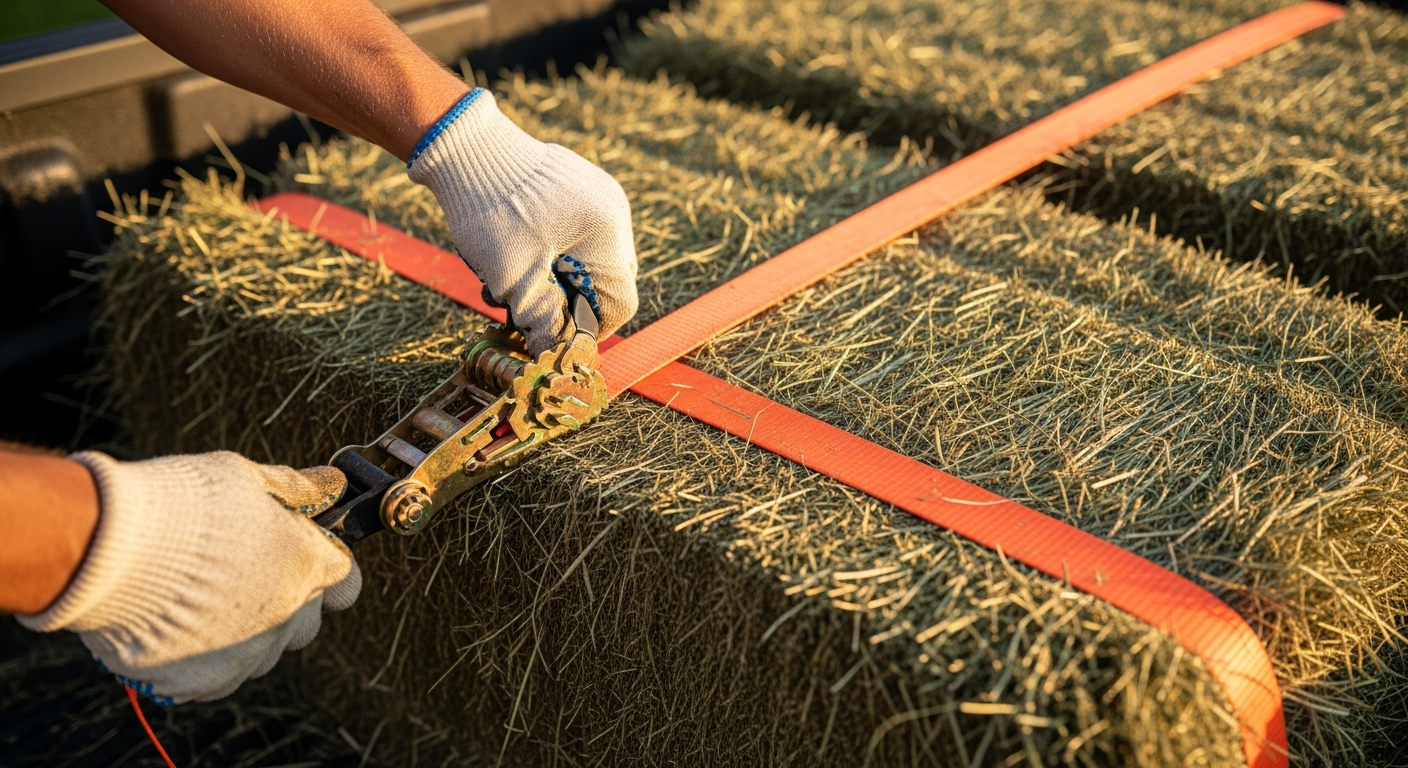
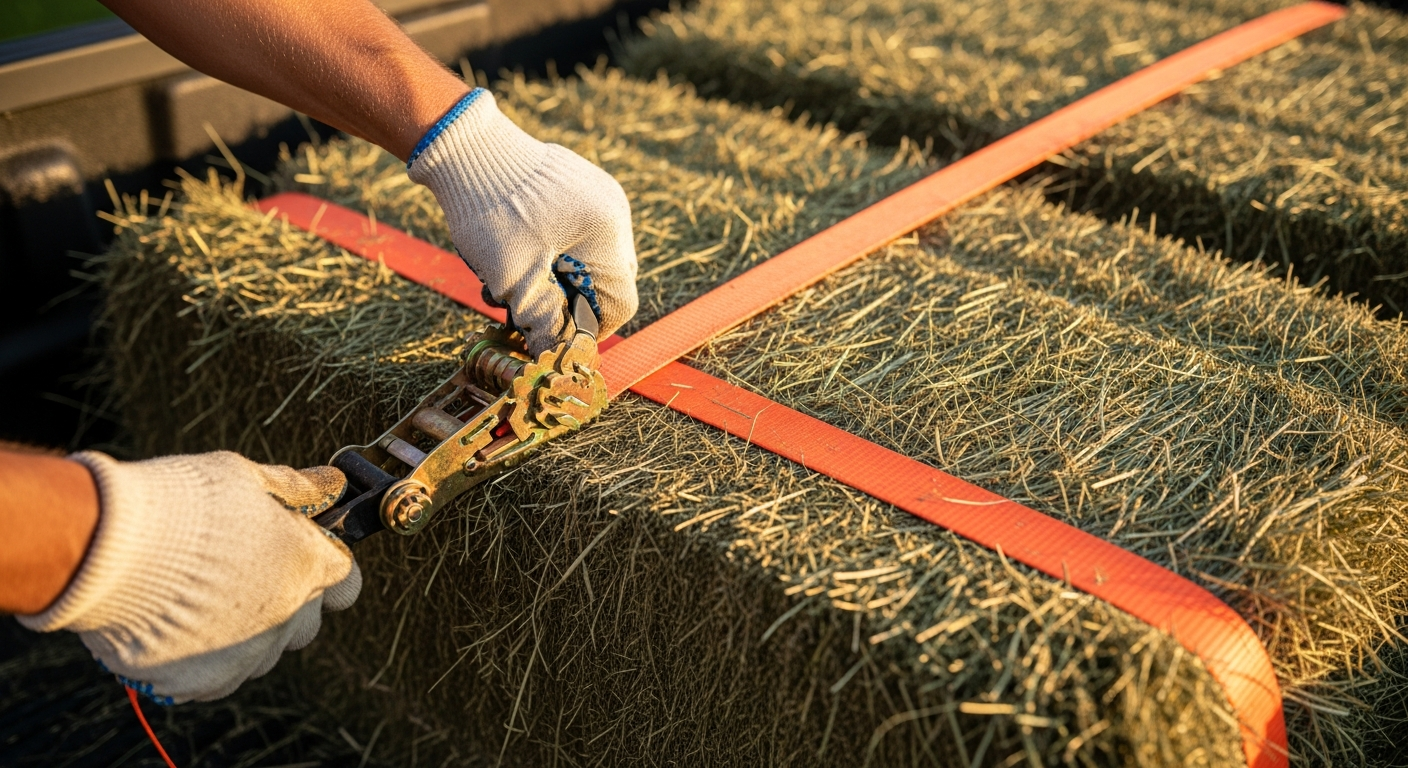
For a pickup truck bed: Use at least 2 ratchet straps over the load — one toward the front and one toward the back.
For a trailer: Use 1 strap per 10 feet of load length, plus an extra strap at the very front and back of the load to keep hay from shifting forward and backward when you brake.
Working load limit (WLL) simplified: Your straps have numbers printed on their tags — that's the WLL for each strap. Add those numbers together. That total has to be at least HALF the weight of your load. So if you have 3,000 lbs of hay, you need straps with a combined WLL of at least 1,500 lbs. Simple as that. (Source: Purdue University / federal DOT guidelines)
One more thing: Stop after the first mile or two and re-tighten your straps. Hay compresses under its own weight once you start moving, which loosens straps more than you'd expect. A quick re-tighten takes two minutes and keeps your load secure the rest of the way home.
Should You Tarp Your Hay Load?
If there's any chance of rain: yes, tarp it. Wet hay molds quickly and can lose 30–50% of its feed value — an expensive mistake when you've just paid for a load. A basic utility tarp secured under or over your straps works fine.
If it's dry and sunny and you're making a short trip, skip the tarp. But if rain is in the forecast or you're making a longer drive, throw one on.
Frequently Asked Questions
What are 21 bales of hay called?
Traditionally, 21 small square bales was called "a load of hay" — that's exactly how many fit on a standard farm wagon. Today the term is used loosely to mean any single truckload, regardless of exact bale count.
How much is a 1000 lb bale of hay worth?
A round bale weighing about 1,000 lbs typically costs $60–120, depending on hay type, region, and season. Alfalfa commands higher prices than grass hay. Prices tend to rise in late winter when stored hay supplies get tight.
How to load hay on a trailer?
Organize bales by size first. Load the heaviest bales first and distribute weight evenly front-to-back. Stack small square bales flat in alternating directions so they interlock. Secure with ratchet straps — at least 1 strap per 10 feet of trailer length — and stop after the first mile to re-tighten.
Is it legal to haul hay without straps?
No. Federal DOT regulations require all loads on public roads to be secured, and farmers hauling hay are not exempt. Use at least 2 ratchet straps for a pickup truck load, with a combined working load limit equal to at least half your load's total weight.