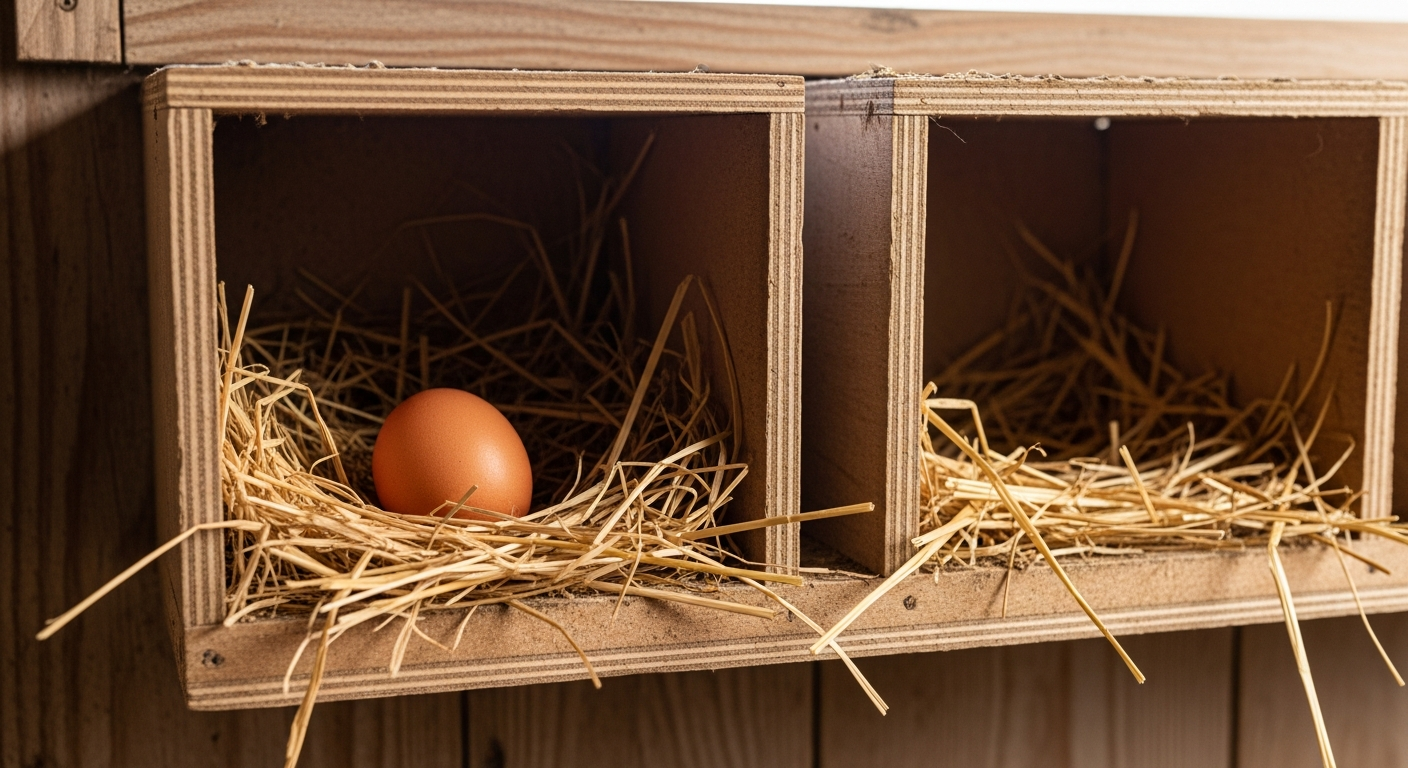
How Many Nesting Boxes Per Chicken (Plus the Table Every New Keeper Needs)
Last updated: March 12, 2026
The rule is 1 nesting box per 4–5 hens, with a minimum of 2 for any flock. Here's what you need by flock size — and below that I'll cover sizing, placement, bedding, and the most common problems new keepers run into.
Quick Snapshot: Nesting Box Numbers by Flock Size
| Flock Size | Nesting Boxes Needed | Notes |
|---|---|---|
| 1–4 hens | 2 | Always 2 minimum — even solo hens need a backup |
| 5–8 hens | 2–3 | 3 is better if you have space |
| 9–12 hens | 3 | Standard backyard flock; 3 is the sweet spot |
| 13–16 hens | 4 | |
| 17–20 hens | 4–5 | |
| 20+ hens | 1 per 4–5 hens | Hens will still prefer 2–3 "favorite" boxes regardless |
The Rule — and Why "One Per Chicken" Is Overkill
When I set up our first coop, I had six hens and genuinely wondered if I needed six boxes. That felt right — one per bird, everyone gets her own space. It turns out I didn't need six, and here's why: hens don't all lay at the same time. Peak laying happens in the morning, but it's staggered across a few hours, so boxes turn over naturally throughout the day. Even in a flock of heavy layers, you'll rarely have more than 3–4 hens trying to lay at the exact same moment.
The minimum of 2 boxes for any flock size isn't about math — it's about backup. Even with just 3 or 4 hens, giving them a second option prevents the standoff at box #1 when two hens decide they need it at the same time. You'll know this standoff when you see it: one hen settled in the box, one pacing in front of it and making everyone's morning unpleasant.
If you're starting fresh and buying rather than building, a 4-compartment unit covers most backyard flocks all the way up to 20 hens — and it's honestly the simplest setup for a first coop.
What Happens If You Have Too Few Nesting Boxes
This is where things can actually go wrong, so it's worth understanding before you finalize your setup.
Broken eggs lead to egg eating. When hens crowd into the same box at the same time, eggs crack. Once a hen tastes a cracked egg and discovers it's food, she'll start actively seeking out eggs to eat — and this habit is very hard to break once it starts. An egg-eating hen can wipe out your egg supply quietly, one egg at a time, and you won't always catch her in the act. This is the biggest real risk of too few boxes, and it's the main reason the rule exists.
Floor eggs become a problem. A hen with an urgent need to lay won't always wait patiently for an occupied box to open up. Sometimes she'll just lay on the coop floor. Floor eggs are harder to find (especially in deep litter), get dirty faster, and break more easily underfoot. I've lost a week of eggs this way when two of my hens decided box #1 was the only acceptable box and box #2 apparently didn't exist.
The flock gets stressful. The standoff behavior — squawking, pacing, jostling — creates low-grade chronic stress for everyone in the coop. It's funny to watch once; after a week of it, it wears on both the hens and you. Adding a box costs less than $30–$40, which is a lot cheaper than the stress and lost eggs.
Can You Have Too Many Nesting Boxes?
The short answer is: not really, but 1 box per hen is overkill. Extra boxes take up coop space that could be better used for run access or additional roosting bars, and every box you add is another box you'll need to clean and maintain — even if your hens never touch it.
The real-world truth is that hens use 2–3 favorite boxes consistently and mostly ignore the rest. There's a great observation from BackYard Chickens that captures it perfectly: one keeper gave her flock 15 boxes and they used 2 most of the time, occasionally rotating to a third. More boxes didn't change anything for them. If you've already hit the 1:4 ratio, adding more won't get you better egg production. If you already have more boxes than you need, don't worry about it — just keep them clean.
Why Do My Hens All Use the Same Nesting Box?
If you set up four boxes and all your hens are stacked into one while the others sit empty — that's completely normal. Here's what's happening.
Hens are hardwired to lay where they can see or smell existing eggs. It's an evolutionary signal that the spot is safe and has been chosen before. The "best box" in their opinion is usually the one the alpha hen or most prolific layer picked first, and the rest of the flock follows her lead. You'll sometimes see all your hens lined up outside that one box, waiting their turn, while three perfectly good boxes sit empty. Chickens are not logical.
You have two options here. The first is to do nothing — if the boxes aren't overcrowded, this isn't actually a problem. The second is to place ceramic nest eggs (fake eggs) in every box to "activate" all of them as viable laying sites. The signal it sends to the flock is that other hens have already laid there, which makes each box feel like a safe choice. I keep a couple in each box and it genuinely distributes the laying better than leaving boxes empty.
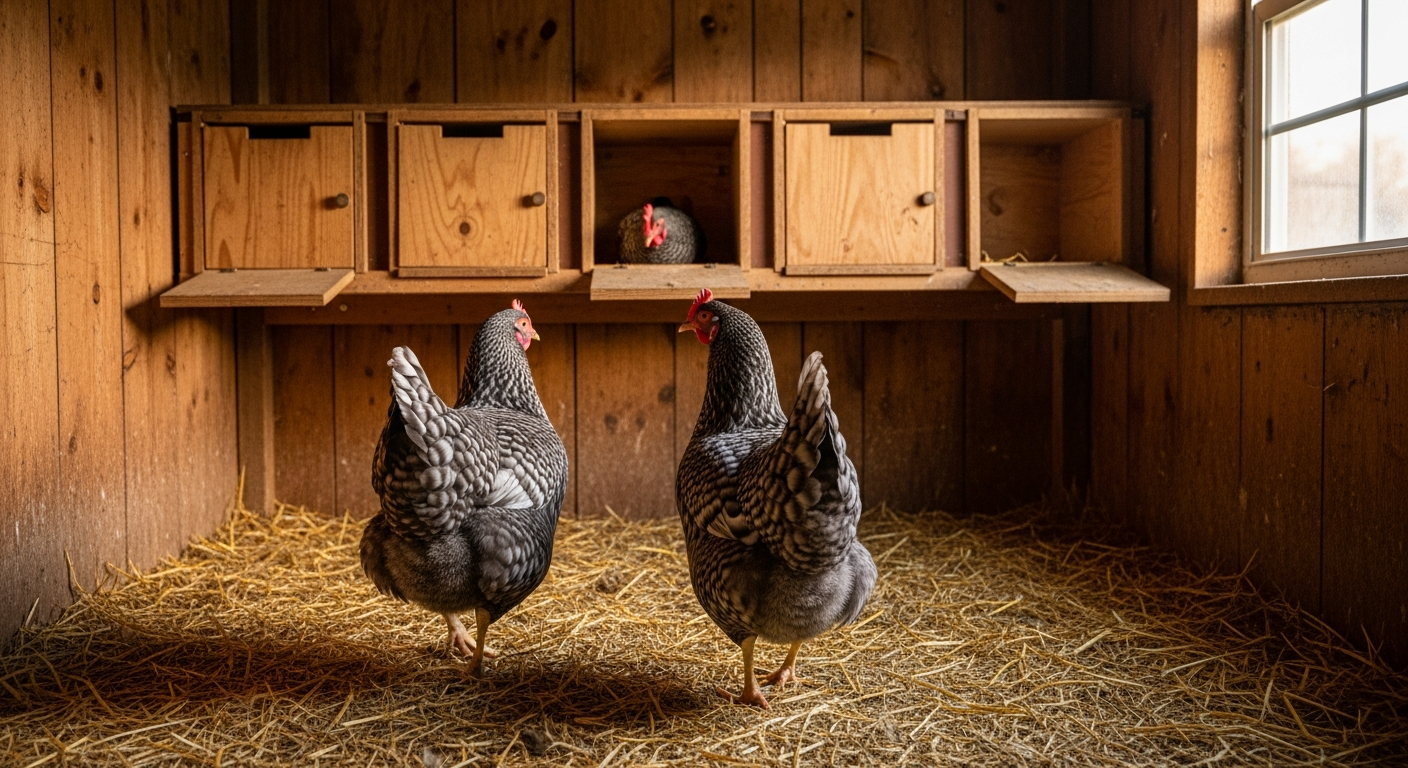
What Size Should a Nesting Box Be?
Snug is better than spacious. A box that's too large lets two hens pile in at the same time, which leads to cracked eggs. The hen should be able to turn around comfortably, but not have extra room to share.
| Chicken Size | Nesting Box Size |
|---|---|
| Bantam breeds | 10" × 10" × 10" |
| Standard breeds (most backyard hens) | 12" × 12" × 12" |
| Large breeds (Buff Orpingtons, Jersey Giants, Brahmas) | 14" × 14" × 14" |
One practical note if you're DIY-ing: slant the top of the boxes so hens can't stand and roost on top. Flat-topped boxes become a poop ledge pretty quickly, which dirties the inside and the bedding below.
Where Should Nesting Boxes Go in Your Coop?
Three rules that actually matter:
1. Lower than the roosts — always. Chickens instinctively go to the highest point they can find to sleep at night. If your nesting boxes are the highest structure in the coop, they become sleeping quarters instead of laying boxes, which means poop in your nesting material and dirty eggs every morning. Your roosts should be at least 4–6 inches higher than the tops of the boxes.
2. Twelve to 18 inches off the floor. This keeps boxes out of the deep litter zone, makes egg collection easier on your back, and reduces the chance of ground-level critters nosing around inside. Higher than 18 inches and you'll have some hens who struggle to get in and out — especially older or heavier birds.
3. A darker corner is better than a busy traffic area. Hens want privacy when they're laying, just like they'd seek out a tucked spot in the wild. A box that faces the main coop door or a busy traffic area gets less use than one in a quieter corner. I put old dish towels over our box openings when we first set up our coop, and almost immediately had all six hens laying in the boxes instead of in the corners of the coop floor.
What to Put in Chicken Nesting Boxes
There are three main options, and they each have real tradeoffs:
| Bedding | Pros | Cons | Best For |
|---|---|---|---|
| Pine shavings | Affordable, easy to freshen, hens like scratching in it | Hens kick it out constantly | Budget-friendly setups |
| Straw | Traditional, insulating, hens tend to like the texture | Mold risk if damp, harder to clean out fully | Dry climates |
| Nesting pads | Cleanest option, reusable, no kicking-out problem | Higher upfront cost | Keepers who hate constant refreshing |
My current system: I use nesting pads as the base layer and add a thin layer of pine shavings on top. The pad doesn't move no matter how much the hens scratch around — it's what they actually nest on. The shavings on top are what they kick out and rearrange, which keeps them occupied without destroying the base layer. One pad lasts me months before it needs replacing.
A bonus tip from Prairie Homestead that I've adopted: tuck a small bundle of dried lavender or mint into the corner of each box. It deters mites and smells much better than a plain chicken coop.
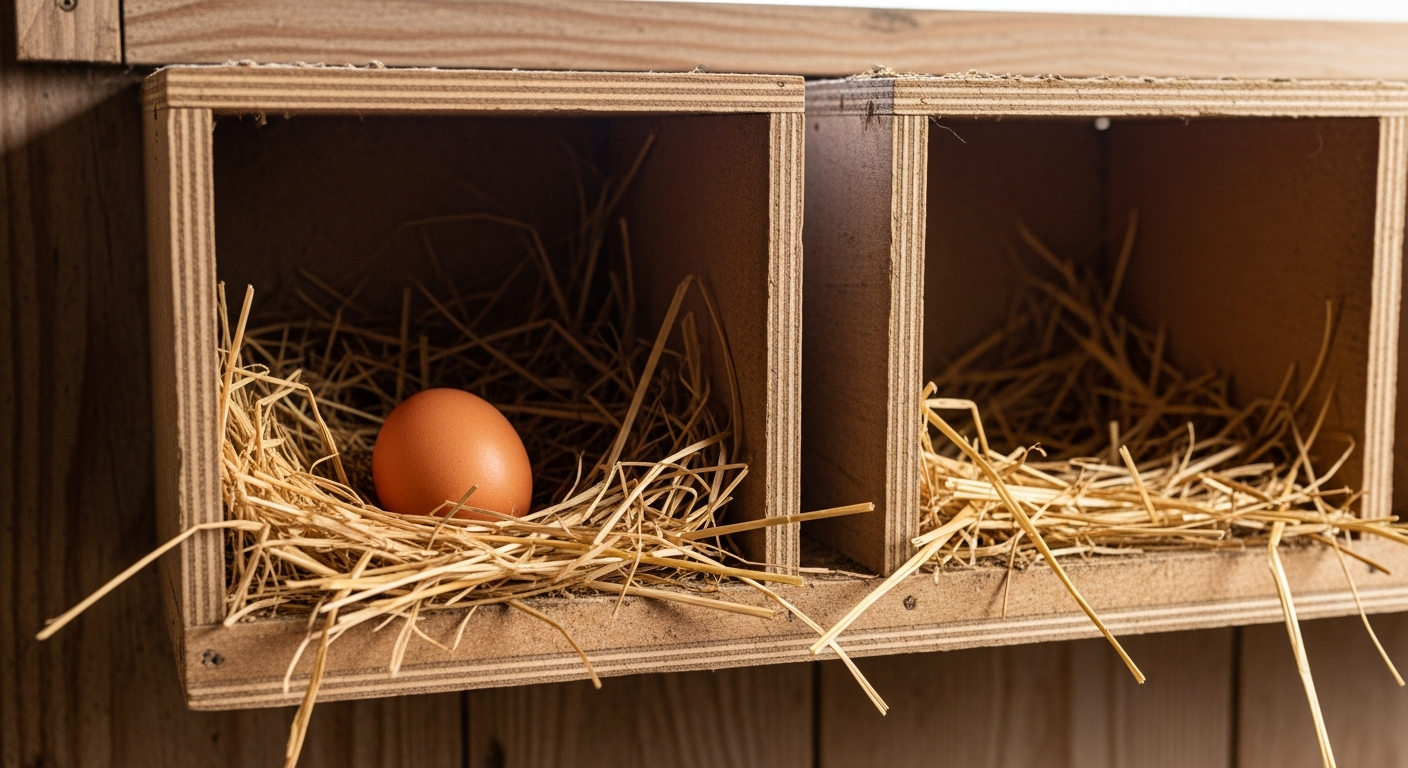
Common Nesting Box Problems (And How to Fix Them Fast)
Chickens Are Sleeping in the Nesting Boxes
Why it happens: Your roosts aren't high enough or long enough. Every bird needs 8–12 inches of linear roost space, and if the roost is crowded, the lower-ranking hens get bumped off and settle for the boxes instead.
Fix: Raise your roosts 4–6 inches above the tops of the boxes, and make sure there's enough roost bar for everyone. If the sleeping-in-boxes habit is already established, physically block the box openings at night for 1–2 weeks — close them at dusk and open them at dawn. It's a little tedious, but it breaks the habit reliably.
Hens Are Laying on the Coop Floor
Why it happens: Boxes are too high, too bright, have no bedding, or your hens simply haven't been introduced to them yet (common with a new flock).
Fix: Add bedding to the boxes, lower them if they're above 18 inches, and place fake eggs in each box to signal that it's a safe laying spot. Confine your hens inside the coop until around 10am for about a week — most laying happens in the morning hours, so this routes them through the boxes before they have a chance to find a floor spot they like better.
Eggs in the Nesting Boxes Are Dirty
Why it happens: Almost always one of two things — hens are sleeping in the boxes (see above), or the bedding is overdue for a refresh.
Fix: Refresh bedding every 1–2 weeks. If you're using nesting pads as a base, they're much easier to clean than loose straw or shavings. Collect eggs daily — eggs that sit in a box for hours get dirty faster and are more likely to attract attention from curious hens.
A Hen Won't Leave the Nesting Box
Why it happens: This isn't a nesting box problem — it's a broody hen. A broody hen is trying to hatch eggs and will sit on that box for 21 days if you let her, blocking other hens from using it and stopping production herself.
Fix: Broody behavior is its own topic, but the short version is: repeatedly remove her from the box (annoying but effective), or let her set if you actually want chicks. Either way, it has nothing to do with your nesting box setup being wrong.
Frequently Asked Questions
How many nesting boxes do I need for 6 chickens?
Two boxes at minimum. Three is better if you have the coop space — it gives your hens more options and reduces competition during peak morning laying.
How many nesting boxes do I need for 10 chickens?
Three boxes covers a flock of 10 with room to spare. Based on the 1:4–5 rule, 10 hens technically need 2–3 boxes, but 3 is the practical sweet spot for most standard-size backyard flocks.
How many nesting boxes are needed for 12 hens?
Three at minimum; four is ideal for a flock of 12. Three meets the rule, but four gives you a buffer if your hens are heavy layers or if one box gets blocked by a broody hen.
How many nesting boxes for 20 chickens?
Four to five boxes. The 1:4–5 rule puts 20 hens at 4–5 boxes. In practice, most flocks this size use 3–4 favorites consistently, but having 5 available means you're always covered even during peak laying.
Do I need a nesting box for every chicken?
No. Hens share nesting boxes, and 1:1 is overkill. The standard is 1 box per 4–5 hens, with 2 as the absolute minimum regardless of flock size.
Can chickens share nesting boxes?
Yes — and they prefer to. It's completely normal to see two hens in one box while others sit empty. Hens are drawn to boxes where eggs are already present, so sharing is instinctive rather than a sign something is wrong.
How do I stop chickens from sleeping in nesting boxes?
Make sure your roosts are higher than your boxes, and that there's enough linear roost space for your whole flock (8–12 inches per bird). If hens are already in the habit of sleeping in boxes, block access at night for 1–2 weeks until they reroute to the roost.
How often should you clean nesting boxes?
Refresh the bedding every 1–2 weeks and do a deeper clean monthly. If you're collecting eggs daily, you'll spot dirty boxes before they become a real problem — that daily check is the easiest maintenance habit you can build.